2014 Mercedes S63 AMG Teaser Video
Mercedes has revealed the 2014 S63 AMG in an official Mercedes AMG video
Mercedes has revealed the 2014 S63 AMG in an official Mercedes AMG video out today. The video shows a pass of the license plate with the letter S and 63 that is fitted to the S63 AMG’s aggressive front with large air intakes. The next clip of the video shows the all digital tachometer with a V8 Biturbo badge while revving the engine in park. And lastly the video shows a quick glimpse of the dual sound quad exhaust just before panning the side of the model.
Though very little official information has been revealed about the S63 AMG in terms of engine output, we expect the V8 5.5 liter twin turbo engine to be paired with a seven speed AMG speedshift transmission that is capable of offering up 550+ HP.
Read the review 2014 S63 AMG by reading the review for more information.
2014 Mercedes S63 AMG Review
AMG chief Ola Källenius and engineering director Tobias Moers show of the 2014 Mercedes S63 AMG
In an effort to build hype around the yet-to-be-revealed 2014 S63 AMG, select members of the press were invited by AMG chief Ola Källenius and engineering director Tobias Moers to review the forthcoming model. One of these press members – Automobile – had the chance to get behind the wheel of the S63 AMG, or more specifically, a long-wheelbase 4Matic, the first we’ve seen for the S63 AMG. Some unique features found the new S Class AMG (many of which we’ve already detailed) include an exhaust that’s capable of playing two different sounds to suit your mood and a silver box battery that is filled with lithium ion energy cells that help cut the AMG’s weight by 44 pounds over the S500 battery.

2014 Mercedes S63 AMG Front Grille
“All in all, we managed to reduce the weight by 220 pounds,” says Moers. “All body panels, the roof, and the entire front-end structure are made of aluminum.”
It is not just the exterior of the Mercedes S63 AMG that received an aggressive facelift – the interior is far more sporty and more luxurious than the standard S-Class. The S63 AMG’s interior sports reshaped seats, perforated nappa leather, an IWC clock, larger shift paddles, a two-spoke steering wheel with a thicker rim, graphics on the virtual speedometer and tach, and AMG badging throughout.
Performance wise, the AMG S-Class can sprint from 0 to 62 mph in 4 seconds flat, or 4.4 seconds in the RWD version. The 585 HP 5.5-liter twin-turbo V-8 reaches a maximum torque of 664 pound-feet available from 2250 to 3750 rpm, and stopping power is provided by carbon-ceramic brakes paired with 21″ wheels (optional) wrapped in 255/40 (front) and 285/35 (rear) tires.
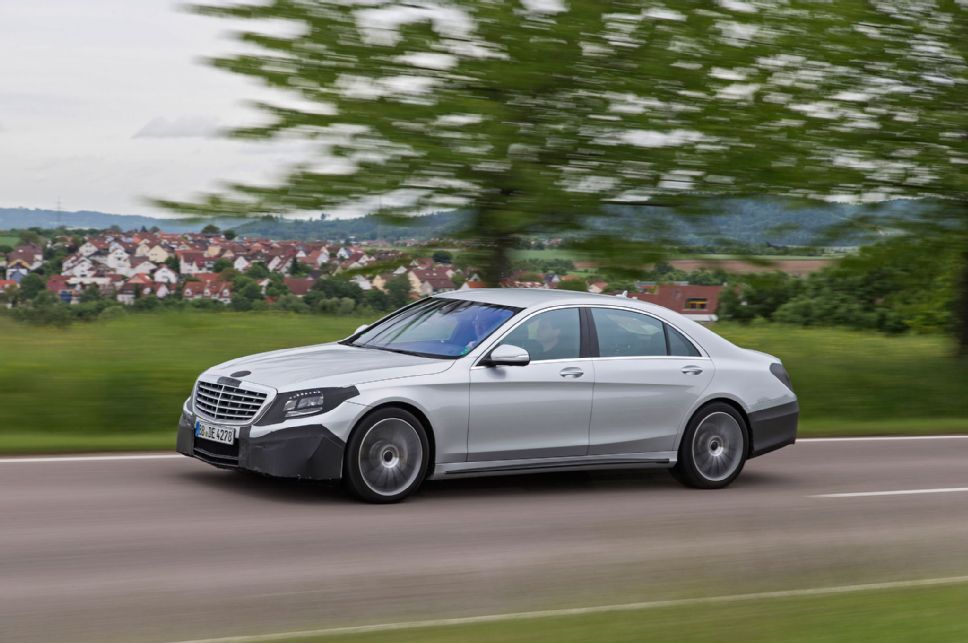
2014 Mercedes S63 AMG Driver’s Side
“Although the power output went up by 41 hp, the real-world fuel economy improved by five percent,” claims Moers. “With this rear-biased AWD system, the S63 AMG can now be driven with almost the same verve as the SL63 AMG. To push out the handling and roadholding envelope even further, we developed an uprated front axle, a variable-ratio sports steering, and a choice of two different chassis settings.” Turn-in on the car is instant – the car’s grip on the road is nearly perfect – the ESP Sport mode allows for minimal sidesteps stays in-line; and lastly, the carbon-ceramic brakes with 16.5″ front rotor allows you to go beyond the apex.
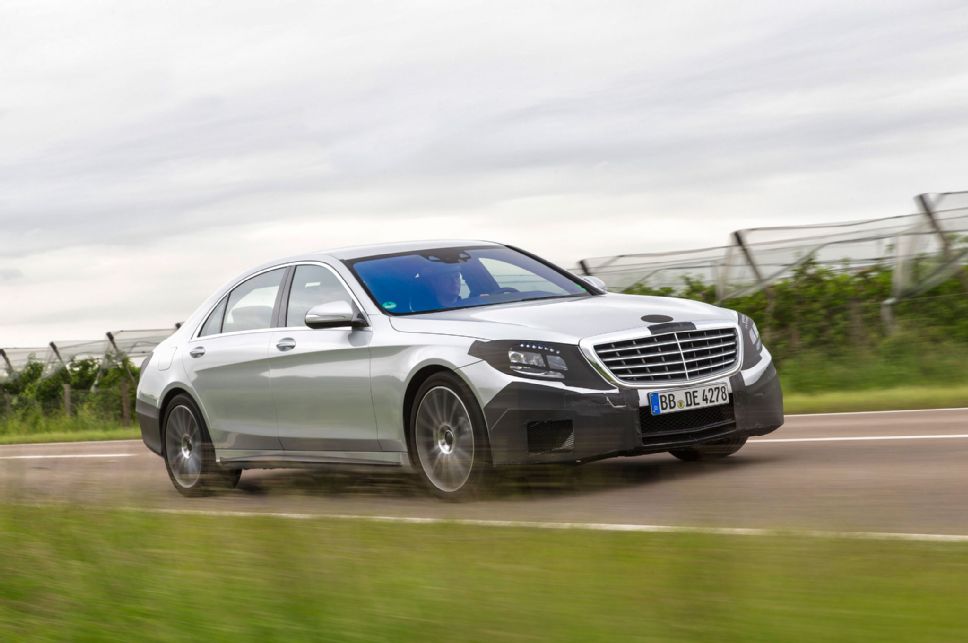
2014 Mercedes S63 AMG Passenger Side
For those of you who think the S63 AMG isn’t quite enough, an even more powerful S65 AMG will be ready in 2014 with atweaked V12 engine that is capable of producing 635 hp and 738 pound-feet of torque.
Check out more photos in the gallery below, courtesy of Automobile.
2014 Mercedes S63 AMG Rendered
2014 Mercedes S63 AMG will be fastest S-Class in Mercedes history
Our good friend Anjan over at IndianAutosBlog was on a trip to Albania last week, and was asked by a person which car they should buy should in the event they were to become the leader of the Albanian Mafia. This is of course a made up scenario but it left Anjan wondering what he would tell this hypothetical person. Below is his recommendation for the hypothetical Albanian mob boss.
While Mercedes announced the standard 2014 Mercedes S-Class, the AMG variant has yet to be announced or even shown. As Anjan pondered over this, his design artist, Shoeb, came out with sketches of what the AMG variant of the world’s best car would look like.
Firstly however, let’s discuss the 5.5-liter V8 Bi-Turbo engine. Seen in its most updated spec on the 2014 Mercedes E63 AMG, the Swabians will offer it in two states of tune: a 557bhp version will churn 720Nm of torque and will form the base. Or, a 577bhp clubbed with 800Nm of torque will propel the car in under 4 seconds.
The top-end model will be offered with the 4MATIC all wheel drive and this could be the fastest and quickest S Class ever made.
Now, on to the renderings, as you can see there are two different options. The first rendering is of the S63 AMG with the ‘Elegance’ grill, the second is fitted with the ‘Avant-Garde’ grill. Which do you prefer? So far with the new Mercedes S-Class only comes with an Elegance grill.

Other features worth looking at are the new, aggressively shaped air dams on the front bumper and the small ‘V8 Bi-Turbo’ badge at the side fender.
2014 Mercedes S63 AMG Spied on the Nürburgring Track
Spy photos of the 2014 Mercedes S63 AMG in minimal camouflage testing on the Nürburgring race track
The all-new 2014 Mercedes-Benz S-Class was revealed only a couple of weeks ago in Hamburg and while we are still making our way through all of the new safety, tech and design features, Mercedes is busy testing additional S-Class variants. Last week we saw multiple spy shots of the S-Class Coupe and now today we have photos of the AMG S-Class. The 2014 S63 was wearing light camouflage as it made it’s way around the Nürburgring race track for testing. We expect the new AMG S-Class to have power provided by a M157 twin-turbo 5.5-litre V8 engine with 570bhp +/-.
While the new front bumper with larger air intakes are hidden under camo, we can see two AMG style exhausts on each side along with a revised bumper. The AMG prototype spied also looks to be sporting bib brakes behind its new AMG wheels.

2014 Mercedes S63 AMG Spy Photo
We will keep you posted as additional details are revealed and expect to see more as its likely reveal at the Frankfurt Motor Show in September gets closer. Thanks to Andrus and GMotors for the photos and tip.
New Mercedes S63 AMG Spied Testing
Mercedes-Benz engineers are believed to have been testing the S63 AMG with AMG-style double exhaust
Thanks to our friends at GMotors, we have the latest round of S-Class Spy photos. Mercedes engineers have been testing the new S-Class for quite a while and this time around, the photogs believe it is the Mercedes S63 AMG, featuring the new AMG-style squared double exhaust outlets they caught.
Besides the AMG-style squared double exhaust outlets, noticeable features include larger brake discs, bigger air intakes and an updated new bumpers, when compared to the standard S-Class.
Power is expected to come from the recently introduced M157 twin-turbo 5.5-litre engine that produces up to 571bhp.
BRABUS Aerodynamic-Enhancement Kit for the Mercedes E-Class and S-Class AMG
The Mercedes S-Class with AMG styling gets a more athletic appearance with additional BRABUS body components
Brabus today unveiled new tuning programs for the Mercedes-Benz E-Class and S-Class AMG models.
Brabus design updates include a revised styling package with a front lip spoiler, a rear diffuser and a trunk-mounted spoiler on both models. Brabus also offers a carbon fiber version which includes all the previously stated components in addition to a stainless-steel sport exhaust system with two different modes.
Additional options include sport front fenders, a bespoke interior and wheel options in sizes up to 20 inches. Being from Brabus, customers can also order engine upgrades for the 5.5-liter and 6.3-liter V8.
BRABUS Aerodynamic-Enhancement Kit for the Mercedes E-Class with AMG Body Styling
The BRABUS designers have modeled a front spoiler lip that attaches to the lower part of the AMG front apron on the sedans and wagons of the latest E-Class. Its sophisticated shape further reduces lift on the front axle for further improved directional stability.
For the sedan there is also a diffuser and rear spoiler that is mounted on the trunk lid. The former features a centrally located reflector, and stylishly blends with the rear bumper. It has cutouts on either side for the tailpipes of the production exhaust or of the BRABUS quad sport exhaust system.
Like the front spoiler the components for the rear are manufactured in OEM quality from Pur-R-Rim plastic ensuring perfect fit and excellent paintability, both in body or in contrasting color. BRABUS also offers these components with a titanium-colored paint finish.
BRABUS Aerodynamic-Enhancement Kit for the Mercedes S-Class with AMG Body Styling
The Mercedes S-Class with AMG styling also gets a more athletic appearance with additional BRABUS body components that are manufactured in OEM quality from Pur-R-Rim as well. The BRABUS aerodynamic-enhancement kit can be painted in body color or come with a glossy titanium paint finish.
The BRABUS front spoiler improves the aerodynamic properties of the luxury sedan. As a result, the car delivers an even smoother ride, particularly at high speeds.
The rear spoiler and diffuser, which also features a centrally located reflector, also contribute to even better high-speed handling.
BRABUS Aerodynamic-Enhancement Kit and Flap Control Exhaust for the Mercedes E 63 AMG
A BRABUS aero update is also available for the E 63 AMG. To further optimize directional stability at high speeds, the BRABUS designers have developed a carbon-fiber front spoiler lip that attaches to the production bumper of the E 63 sedan or wagon. Custom-tailored air ducts from BRABUS lend the side outlets of the AMG apron even more sporty profile.
Also made from super-light composite material are the BRABUS rear spoiler lip and the diffuser insert, which are both reserved for the sedan.
The rear appearance of this model is characterized by the visual trademark of BRABUS, the centrally located reflector. But that’s not all: the diffuser provides the perfect backdrop for the ceramics-coated dual design tailpipes of the BRABUS stainless-steel high-performance exhaust system. Thrilling looks are not the only strengths of the sport exhaust. An integrated flap system lets the driver choose between a discrete ‘coming home’ mode and the sport setting that provides an even more exciting exhaust note, all at the push of a button in the cockpit.
BRABUS Aerodynamic-Enhancement Kit and Flap Control Exhaust for the Mercedes S 63 AMG
The S 63 can be refined in a similar manner: an additional front spoiler made from Formula 1 material of choice carbon fiber for the AMG bumper was modeled for it as well. It benefits the car’s appearance and handling characteristics at high speed.
In addition to the spoiler lip for the trunk lid there is also a center diffuser with reflector for this model. Also in the product program: the stainless-steel BRABUS flap control exhaust system. It features cast-aluminum ceramics-coated tailpipes and a variable exhaust note controlled from the steering wheel that spans the gap from Dr. Jekyll to Mr. Hyde.
The BRABUS program naturally also offers countless additional options for customizing all AMG models. These include custom-tailored BRABUS Monoblock wheels with diameters of up to 20 inches, depending on the model in question. BRABUS front sport fenders, available for all E- and S-Class models, are yet another visual delicacy.
BRABUS wouldn’t be BRABUS if it didn’t offer engine tuning for the various AMG engines. Highlights in this category are the 6.3-liter V8 fast-revving engine and the new 5.5-liter V8 Biturbo engine.
The interior also offers a wide open playing field for refinement. The BRABUS upholstery shop uses supple leather and Alcantara to adapt the interior to the customer’s personal preferences down to the last detail. Other instruments of cockpit refinement are carbon-fiber and exotic wood trim elements available in any desired color and in a number of different designs.
BRABUS Offers Performance Kits for Mercedes-Benz V8 Biturbo Engines
The BRABUS engine specialists have developed two performance kits for each of the new eight-cylinder biturbo engines
German tuner BRABUS is known for offering the most extensive engine tuning program for Mercedes-Benz vehicles and now BRABUS is introducing performance kits for the new Mercedes-Benz V8 biturbo engines that are found on the latest S and CL models (US: S550 and CL550) and the S63 and CL63 AMG models. Depending on the model and the level of tuning, the kits boost power output to up to 620 hp (610 bhp) / 455 kW and peak torque to 1,000 Nm (737 lb-ft). In addition, there are aerodynamic-enhancement components made from exposed carbon fiber, custom-tailored tire/wheel combinations with diameters of up to 21 inches, and exclusive interior options. All components are backed by the one-of-a-kind BRABUS Tuning Warranty® of three years, up to 100,000 kilometers/62,000 miles .
The BRABUS engine specialists have developed two performance kits for each of the new eight-cylinder biturbo engines. BRABUS recommends fully synthetic ARAL high-performance motor oil for all engines.
For the S500 and CL500 models, BRABUS offers the BRABUS B50 – 490 PowerXtra CGI performance kits that sell for EUR 4,900 MSRP. The BRABUS PowerXtra module is a plug-and-play device that is integrated into the engine electronics. After the installation the 4.7-liter (287 cu. in.) eight-cylinder biturbo engine produces a powerful 490 hp (482 bhp) / 360 kW, up from standard 435 hp (429 bhp) / 320 kW. Peak torque grows to 780 Nm (575 lb-ft).
The BRABUS B50 – 520 PowerXtra CGI performance kit, available for EUR 5,900 MSRP, results in a power increase by 85 horsepower for both 500 models. In addition to the PowerXtra module, this version includes a supplementary intercooler. Equipped with this kit, both sedan and coupe reach a top speed of 300 km/h (188 mph) in combination with the BRABUS Vmax Unit. Rated power output is 520 hp (512 bhp) / 382 kW with a peak torque of 820 Nm (604 lb-ft).
In addition to the auxiliary control unit for the engine electronics, the two BRABUS power upgrades for the S 63 and CL 63 models also include a water-to-air intercooler powered by an electric auxiliary pump. The lower charge air temperature in both cases benefits power yield and longevity even under extreme operating conditions.
For the S 63 and CL 63 models not equipped with performance package BRABUS offers the BRABUS B63 – 584 PowerXtra CGI performance kit for EUR 5,900 MSRP. It bumps power output by 40 hp (39 bhp) / 29.4 kW.
For all 63-series models equipped with performance package BRABUS offers the BRABUS B63 – 620 PowerXtra CGI version, which also costs EUR 5,900 MSRP. As the name indicates, after the conversion the biturbo engine produces 620 hp (610 bhp) / 455 kW at just 5,500 rpm. Simultaneously peak torque grows from 900 to 1,000 Nm (663 to 737 lb-ft), available between 2,250 and 3,750 rpm.
In the S63 and CL63 models with BRABUS B63 – 620 PowerXtra CGI tuning sprint time from 0 to 100 km/h (0-62 mph) is shortened to 4.3 seconds. In combination with the integrated BRABUS V/max Unit, top speed increases to up to 320 km/h (200 mph).
The ideal complement to the tuning of the 5.5-liter engine is the BRABUS sport exhaust system with exhaust flap control. At the push of a button on the steering wheel the driver can choose whether to enjoy the V8 sound in the quiet and unobtrusive ‘Coming Home’ or in the markedly throaty ‘Sport’ mode. The fully stainless-steel exhaust system features two ceramic-coated tailpipes with striking design that add some visual thrills as well.
To transfer the increased power to the road with minimum slip, BRABUS offers a limited-slip differential with a locking rate of up to 40 percent for the Mercedes S63 and CL63 models.
For even better directional stability at these extremely high speeds, the BRABUS designers went into the wind tunnel to develop appealing and functional aerodynamic-enhancement components for the body kit of the S 63 AMG. The components are manufactured from exposed carbon fiber.
The BRABUS front spoiler gives the production front apron a visual upgrade and reduces lift on the front axle. The more striking front is rounded out with carbon-fiber moldings for the gills in the sides of the front bumper. BRABUS aluminum sport fenders lend the car a decidedly dynamic appearance.
The BRABUS carbon-fiber diffuser with integrated reflector and the carbon-fiber rear spoiler reduce lift on the rear axle.
Naturally BRABUS also offers custom-tailored BRABUS Monoblock alloy wheels with diameters ranging from 19 to 21 inches for all Mercedes S- and CL-Class models. The wheels are mounted with Pirelli or YOKOHAMA high-performance tires.
Upon customer request BRABUS also refines the interiors of Mercedes-Benz S-Class sedans and CL coupes to suit the owners’ personal tastes.
Mercedes-Benz S63 AMG and the Mercedes-Benz 300 SEL 6.8 AMG
Racing touring car of 1971, the Mercedes-Benz 300 SEL 6.8 AMG, and the S63 AMG showcar together with matching paint
Wide, spectacular and clad in an authentic racing car outfit – two very special S-Class saloon models from the AMG stable. One is the racing touring car of 1971, the 300 SEL 6.8 AMG, and the other is the S 63 AMG showcar. With identical sponsoring and the memorable start number “35”, the new high-performance model is a reminder of a historic success: on July 25, 1971, the bright red four-door saloon crossed the finish line in second place at the 24-hour race in Spa-Francorchamps. This triumph in the car’s very first race made AMG world-famous overnight.
The highly experienced Hans Heyer and Clemens Schickentanz took turns behind the wheel of the AMG touring car. AMG was anything but the favourite to win this classic Belgian long-distance race: it faced the mighty opposition of the Ford Capri RS, BMW 2800 CS, Chevrolet Camaro, Opel Commodore and Alfa Romeo GTA. Nobody expected that the large luxury saloon from Affalterbach in provincial Swabia would be able to keep up with the well-established teams.
5th place in the starting line-up for AMG
The red four-door saloon already showed its potential in training, when Clemens Schickentanz surprised everyone with the fifth-fastest training time. Indeed nobody at AMG had expected fifth place in a starting line-up of 60 cars. 80,000 spectators wondered about the fast, red saloon with its long wheelbase – the only Mercedes taking part in the race. Pole position was occupied by the favourite, the Chevrolet Camaro driven by Ivo Grauls and Peter Hoffmann, followed by the Alpina-BMW 2800 CS of Niki Lauda/Gérard Larousse, then the first works Ford Capri with Dieter Glemser and Alex Soler-Roig, and the Schnitzer-BMW 2800 CS piloted by Rauno Aaltonen and Helmut Kelleners. All in all, 60 racing touring cars were seeking to beat the stopwatch on the then 14.1 kilometre course in the Ardennes, driven by well-known names such as Hans-Joachim-Stuck, Jochen Mass, Toine Hezemans, Willy Kauhsen, Achim Warmbold and Rainer Braun.
On the first lap, driver Hans Heyer in the 300 SEL 6.8 AMG was able to manoeuvre into 3rd place right behind the Ford Capri (Glemser/Soler-Roig) and the Chevrolet Camaro (Grauls/Hoffmann). After a turbulent race with a rainstorm at midnight and numerous breakdowns, the “35” finally crossed the finishing line in second place behind the works Capri driven by Glemser/Soler-Roig. The AMG saloon had absolved exactly 308 laps in the 24 hours. Technical problems: none at all. A sensational result.
Top speed of 265 km/h and exotic wood trim in the cockpit
Hans Heyer looks back fondly on this race: “We knew we could win, but the others did not know that yet!” The AMG saloon was unbeatable on the straight, however the braking system substantially adopted from the standard model had problems coping with the weight of the car (1635 kilograms). “But on the old Spa course the discs had plenty of time to cool down, and nobody was able to catch us on the long straights,” the now 67 year-old reminisces. With a top speed of 265 km/h, the 300 SEL 6.8 AMG was tailor-made for the fast Belgian track. The interior had a luxurious atmosphere with its standard appointments such as power steering, air suspension, carpets, panelled doors and a dashboard with exotic wood trim. The spectators along the trackside enthusiastically cheered the large saloon with its unmistakable V8 sound. “The outsider quickly became the public’s favourite,” says Hans Heyer.
The AMG racing saloon was technically based on the Mercedes-Benz 300 SEL 6.3. With an engine output of 184 kW (250 hp) at 4000 rpm and a top speed of 220 km/h, this luxury saloon was Germany’s fastest regular production car at the time. It was not only an enlarged displacement from 6330 to 6835 cc that increased the output to 315 kW (428 hp) at 5500 rpm, and torque from 500 to 608 newton metres. AMG co-founder Erhard Melcher “tweaked” the eight-cylinder power unit using classic methods: high-precision camshafts and modified rocker arms, lighter connecting rods, new Mahle pistons, larger intake valves, modified combustion chambers, polished intake and exhaust ducts, a new intake tract with two throttle flaps and a racing exhaust system ensured a better gas throughflow and made higher engine speeds possible. Endurance was improved by installing an additional oil cooler and finely balancing the crankshaft.
The wings were flared to make room for the lightweight size 10 x 15 and 12 x 15-inch magnesium wheels adopted from a C 111 test car. Aluminium doors helped to reduce the car’s weight from the original 1830 to 1635 kilograms. Larger front wishbones, a more robust rear axle with a heavy-duty differential and smaller, stiffer suspension air bellows made the saloon fit for the racetrack.
Sensational success reported on German TV news
The unexpected success in the 24-hour race at Spa-Francorchamps made AMG, which was founded in 1967, well-known overnight – and marked the start of an impressive success story. Even the German TV news “Tagesschau” reported on this sensational result. “It really was a sensation at the time,” AMG founder Hans Werner Aufrecht remembers. The courage shown by Aufrecht and his partner Melcher in entering such a car in the classic 24-hour race had been well rewarded.
Afterwards the 300 SEL 6.8 AMG took part in the 2×6 hour race at Paul Ricard on 11 and 12 September 1971, accompanied by a privately entered 300 SEL 6.3 with an AMG engine. In March 1972, now repainted in yellow, the 300 SEL 6.8 AMG took part in the trials for the Le Mans 24-hour race, but did not take to the starting line for the June race. The car was however entered in the 24-hour race at the Nürburgring in June 1972, and in the Nuremberg 200-mile race at the Norisring on 6 August 1972, where Hans Heyer took first place in the “Standard and special touring cars above 2000 cc” category with the four-door saloon, which had meanwhile been painted red again. The success story of the 300 SEL 6.8 AMG came to an end there: a rule-change by the Fédération Internationale de l’Automobile (FIA) put the brakes on this muscular racer, as only cars with an engine displacement of up to five litres were permitted to enter European Touring Car Championship races in future. AMG sold its racing saloon to the French Matra group, where it was converted for high-speed tests on aircraft tyres. Its subsequent fate is unknown. In spring 2006 Mercedes-AMG built a replica of the 300 SEL 6.8 AMG according to the original drawings, so as to keep this unique success story alive.
Spectacular S 63 AMG”Thirty-Five” showcar in the style of the racing touring car
Like its historic predecessor, the new S 63 AMG showcar does not fail to attract attention. Eye-catching details include the imposing tyre sizes of 275/35 R 20 and 325/30 R 20 at the front/rear, and the 4.5 cm flare on each wing. The start number 35 and practically all the sponsoring stickers follow the original. Instead of fire-red non-metallic paintwork, the body of the showcar is finished in “AMG Le Mans red metallic”, a colour available exclusively for the new SLS AMG. The functional interior is enhanced with black/carbon-fibre piano lacquer trim. A rollover cage, two AMG sports bucket seats with four-point seat belts and an AMG sports steering wheel lined in leather/Alcantara underline the racing touring car look. This spectacular showcar provides an outlook on the series production version of the new S 63 AMG, which is due to be launched in September 2010.
“AMG Performance 2015” as the continuation of a success story
The car is powered by the new AMG 5.5-litre V8 biturbo engine and the AMG SPEEDSHIFT MCT 7-speed sports transmission. Mercedes-AMG is continuing this impressive story with its “AMG Performance 2015” strategy, and meeting its promise to continuously reduce both the fuel consumption and emissions of new models with the new engine/transmission combination – while reaching new heights with the central brand value of “performance”.
The new AMG 5.5-litre V8 biturbo engine will play a major part in the Mercedes-AMG model strategy over the next few years. The unique AMG SPEEDSHIFT MCT 7-speed sports transmission will also guarantee a thrilling yet economical power transfer in future AMG high-performance cars. The new engine/transmission combination is another milestone in the success story of Mercedes-AMG, which
began in 1967. Another highlight in the company’s more than 40 year history is undoubtedly the SLS AMG: this gull-wing model which was launched in March 2010 is the first automobile to be completely independently developed by Mercedes-AMG. It means that as the performance brand within Mercedes-Benz Cars, AMG is not only fielding a masterpiece but also demonstrating development expertise at the highest level.
Direct petrol injection with spray-guided combustion and twin turbocharging
With an overall displacement of 5461 cc, the new AMG 5.5-litre V8 biturbo unit makes do with exactly 747 cubic centimetres less compared to the naturally aspirated AMG 6.3-litre V8 with a displacement of 6208 cc. In addition to downsizing, AMG is also utilising the advantages of direct petrol injection with spray-guided combustion and piezo-electric injectors: thanks to its higher thermodynamic efficiency, this technology makes more efficient use of fuel and leads to lower exhaust emissions. AMG combines this spray-guided combustion with twin turbochargers. Other highlights include a crankcase wholly of aluminium, four-valve technology with adjustable camshafts, an air/water intercooler, generator management and a start/stop function as standard.
This high-tech package leads to a high output and torque yield, together with fuel consumption figures that are unrivalled in the competitive lineup. The AMG 5.5‑litre V8 biturbo engine develops a peak output of 400 kW (544 hp) and maximum torque of 800 newton metres. In conjunction with the AMG Performance package these figures are increased to 420 kW (571 hp) and 900 newton metres. The major difference between the two performance classes is an increase in the maximum charge pressure from 1.0 to 1.3 bar. A look at the performance diagrams shows that no other engine in this output class achieves the figures delivered by the new AMG biturbo.
Quantum leap: fuel consumption reduced by 25 percent
With a provisional NEDC fuel consumption of 10.5 litres per 100 kilometres, the new S 63 AMG is 3.9 litres more economical than the preceding model powered by the naturally aspirated AMG 6.3-litre V8 – despite an increase in output by 14 kW (19 hp) resp. 34 kW (46 hp) and in torque by 170 and 270 newton metres. Engine specialists consider this achieved fuel saving of more than 25 percent to be nothing less than a quantum leap. CO2 emissions have likewise been significantly reduced: at 246 grams per kilometre, the figure is 28.5 percent lower than for the previous model. Both performance variants have identical fuel consumption and CO2 figures.
With figures like these, the new S 63 AMG is not only considerably better than all its competitors, but also more fuel-efficient than much less powerful cars in this segment. In some cases, in terms of its enormous output and torque figures, the new AMG 5.5-litre V8 biturbo engine is twice as efficient as many a medium or compact class diesel engine.
At the same time the S 63 AMG delivers superior performance at sports car level: the high-performance saloon accelerates from zero to 100 km/h in 4.5 seconds, and has an electronically limited top speed of 250 km/h. The 100 km/h mark is reached in just 4.4 seconds with the AMG Performance package, with the top speed increased to an electronically limited 300 km/h.
Engine production – tradition of hand-built excellence
Like all AMG engines, the new eight-cylinder biturbo is assembled by hand in the AMG engine shop taken into commission in 2002. A single, highly-qualified technician assembles the M 157 according to the “one man, one engine” philosophy, maintaining the very strictest quality standards – as attested by his signature on the characteristic AMG engine plate.
Exciting power delivery, characteristic sound
These figures raise high expectations which the 400 kW (544 hp) AMG 5.5-litre V8 biturbo certainly meets. The flat torque curve ensures enormous pulling power in all speed ranges: 670 newton metres are already available at 1500 rpm, and the maximum torque of 800 newton metres is delivered just 500 rpm later, remaining constant to 4500 rpm. Even more effortless performance is ensured by the engine variant with the AMG Performance package, which has a peak output of 420 kW (571 hp). In this case the eight-cylinder delivers 875 newton metres of torque at just 2000 rpm, with a constant 900 newton metres available between 2500 and 3750 rpm.
It is not only the unrivalled torque delivery of this turbocharged eight-cylinder that makes the heart beat faster, as the agile responsiveness with no irritating charger delay leads to an effortlessness and dynamism previously unknown in this output class. All perfectly matched by the characteristic, sonorous engine note. Moreover, this AMG high-performance engine naturally meets all the requirements with respect to smooth, quiet running and the comfort on long journeys that is to be expected of a Mercedes.
MCT 7-speed sports transmission with Controlled Efficiency mode and start/stop function
Power is transferred by the AMG SPEEDSHIFT MCT 7-speed sports transmission used exclusively by AMG, which is already familiar from the SL 63 AMG and E 63 AMG and combines high emotional appeal with outstanding driving dyna-mics and a high level of efficiency. The wet start-up clutch replaces a conventional torque converter, and helps to save fuel. The exemplary fuel economy is also in large measure due to the standard start/stop function. This system is active in the transmission’s Controlled Efficiency (“C”) mode, and switches the eight-cylinder engine off when the car comes to a stop. In “C” mode the sports saloon always starts off in second gear, and the transmission shifts to the next, higher gears at a decidedly early stage. With its high torque at low engine speeds, the V8 engine encourages a smooth, effortless driving style.
The eight-cylinder biturbo engine also features the generator management system familiar from the E 63 AMG: whenever the engine is on the overrun or when braking, kinetic energy is used to charge the battery rather than being wasted as heat in the usual way. In all other operating modes a combination of onboard network and generator management enables the generator to be kept at a low voltage. This reduces the load on the engine and makes for fuel savings of around 0.15 litres per 100 kilometres according to the NEDC standard, and up to 0.2 l/ 100 km in city traffic with its frequent overrun and braking phases.
Long tradition of powerful AMG V8 engines
Powerful eight-cylinder engines are an inseparable part of AMG’s corporate history. One milestone in this history was the M 117, the first eight-cylinder with four-valve technology: with a displacement of 5.6 litres, 265 kW (360 hp) and 510 newton metres of torque, this V8 accelerated the Mercedes-Benz 300 CE 5.6 AMG to a top speed of 303 km/h in 1987. This made the coupé Germany’s fastest series-production car; American AMG fans reverently christened it “The Hammer”. Another important engine in the history of AMG was the supercharged AMG 5.5-litre V8 introduced in 2001: the M 113 K developed an output of up to 428 kW (582 hp) and torque of 800 newton metres. The supercharged AMG 5.5-litre V8 in the SLR McLaren of 2003 was even more powerful – it developed up to 478 kW (650 hp) and 820 newton metres. 2005 saw the debut of the AMG 6.3-litre V8 engine; depending on the model, the naturally aspirated, high-revving M 156 developed up to 386 kW (525 hp) and 630 newton metres. Exclusively reserved for the new SLS AMG, the likewise 6.3-litre M 159 has a maximum output of 420 kW (571 hp) and maximum torque of 650 newton metres.
The supercharged AMG 5.5-litre V8, the AMG 6.3-litre V8 and the AMG 6.0-litre V12 biturbo were all able to win the Best Performance Engine category in the International Engine of the Year Awards.
Hans Heyer highly successful in touring car and sports car races
Hans Heyer, born in Mönchengladbach on 16 March 1943, has taken part in 1000 races in more than 35 years of motorsports. He has competed as a works driver for many brands, including AMG-Mercedes, Ford, Lancia, Porsche, Jaguar and BMW. Heyer is Germany’s most successful Go-Kart driver of all time, winning four European championships, two world vice-championships, four German championships and two Dutch championships. He won the precursor to the DTM series three times, the German motor racing championship and achieved three first places in the 24-hour race at Spa-Francorchamps. In 1974 he crowned this successful career with the European touring car championship title.
Heyer was also very successful with prototype sports cars, with victories including the 1000-kilometre races in Monza, Mugello, Kyalami and on the Nürburgring. He also competed in the 24-hour race in Le Mans several times, and became sports car brand world champion in 1976 and 1980. In 1977 Hans Heyer even competed in a Formula 1 race for ATS.
In 1985 Hans Heyer took to the starting line for the Paris–Dakar marathon rally, winning the truck category and taking 28th overall place. In 1986 and 1987 Heyer worked as a development and test driver for the AMG-Mercedes team, and also as racing manager in 1988 and 1989. In 2004 Hans Heyer announced his final retirement from active racing after his 1000th race. His son Kenneth, aged 29, has followed his father’s footsteps and is entering the ADAC GT Masters and the FIA GT European championships in 2010.
Tyrolean hat as a trademark
Hans Heyer’s trademark was his Tyrolean hat: he elevated this striking head cover into a trademark over several decades – and it also “opened doors” for him automatically. “There were times when I did not need to show identification for anything. My hat was so well-known that I got in everywhere, even at Formula 1 events.”
Clemens Schickentanz still active today
The greatest sporting successes of Clemens Schickentanz, born on 24 May 1944 in Coesfeld, include overall victory in the first ever 24-hour race on the Nürburgring in 1970, together with Hans-Joachim Stuck. Even more publicity was assured by the second place with the 300 SEL 6.8 AMG at the 24-hour race in Spa-Francorchamps with Hans Heyer in 1971. In 1973 Clemens Schickentanz won the GT European championship and the Porsche Cup; at the 24-hour race in Le Mans he took 3rd and 4th place in 1973 and 1983. His race record is also studded with numerous victories in 1000 km races. Clemens Schickentanz has never officially ended his active carer as a racing driver, and still appears on the starting line for classic car races.
The driver duo of Hans Heyer/Clemens Schickentanz was not only successful with the Mercedes-Benz 300 SEL 6.8 AMG. In 1978 they drove the new 450 SLC 5.0 AMG in the European touring car championships. At the end of the season they had achieved two third places in Monza/Italy and on the Salzburgring in Austria. In 1980 Clemens Schickentanz alternated with Jörg Denzel behind the wheel of the silver coupé. After a second place in Monza, they achieved their first victory in the Touring Car Grand Prix on the Nürburgring.
Legendary racetrack with many bends: Spa-Francorchamps
The Spa-Francorchamps racetrack in the Belgian Ardennes was opened in 1921, and is regarded as hallowed ground by racing drivers and fans – it almost has the same legendary appeal as the North Loop of the Nürburgring.
The seven kilometre long circuit is already very special because of its very varied course and very considerable differences in altitude, which is why it is often
referred to as the “Ardennes Rollercoaster”. Spa-Francorchamps is world-famous by virtue of its notorious “Eau Rouge” combination of bends. Shortly after the starting/finishing line and the “La Source” hairpin, the track dips into a fast left/right combination. This is immediately followed by a respectable uphill gradient transitioning into the fast and also blind “La Radillon” left-hand bend.
A test of courage for any racing driver. There is only space for one car to pass through this demanding combination of bends – no chance for two or even three abreast. It is also important to take the ideal line to gain impetus for the long “Kemmel” straight that follows. Another key point is the ultra-fast double left-hander named “Blanchimont”, where speeds of up to 300 km/h are attained before the racing cars have to be braked hard to take the “Bus Stop” chicane.
“Eau Rouge” is particularly synonymous with exciting racing incidents – but has also been the scene of tragic accidents in the past. The extraordinarily talented German driver Stefan Bellof lost his life at Eau Rouge on 1 September 1985, during a sports car race. Following numerous rebuilding measures on this bend and other stretches, passive safety has been drastically improved for both the drivers, the spectators and the track marshals.
World Champion Michael Schumacher holds the lap record
The official lap record in Spa-Francorchamps is held by the seven-times World Champion Michael Schumacher: his lap time of 1:43.726 minutes dates from 2002, and corresponds to an average speed of 241.837 km/h. Mercedes-GP-Petronas driver Michael Schumacher on the Belgian Grand-Prix track: “This racetrack is one of the few that has retained its historic charm – and one of the last where the drivers really make the difference.” AMG Mercedes DTM driver David Coulthard: “I would say that at least 90 percent of all drivers consider Spa-Francorchamps to be their favourite course.”
Spa-Francorchamps is now the venue for the Belgian Grand Prix Formula 1 race (27 to 29 August 2010) and the 24-hour race (31 July to 1 August 2010) – the very event in which the 300 SEL 6.8 AMG achieved its second place in 1971.
2011 Mercedes-Benz S63 AMG Active and Passive Safety
The 2011 Mercedes-Benz S63 AMG offers a unique combination of trend-setting driver assistance systems
Throughout the world the Mercedes-Benz S-Class is synonymous with the ultimate in active and passive safety systems. A significant part of such systems is also made up of the unique combination of trend-setting camera and radar-based driver assistance systems. The latest innovations are called Active Lane Keeping Assist and Active Blind Spot Assist, both of which are available as optional extras.
The combination of state-of-the-art assistance and protection systems turn the AMG S-Class into an “intelligent” partner which is able to “see”, “feel”, to respond “instinctively” to detected dangers and to act “on its own initiative” in order to avoid accidents or to reduce the severity of accidents. The vehicle makes use of cameras radar sensors which look far ahead, observe the conditions around the vehicle, and are able to interpret typical critical situations.
When the S 63 AMG unintentionally drives over a solid line to the right or left of a lane or on the outside of a bend, the new Active Lane Keeping Assist intervenes and prevents the vehicle from unintentionally leaving the lane. In such cases it applies the brakes to the wheels on the opposite side of the vehicle, using the sensor system of the Electronic Stability Program ESP®.
Similarly, when the new Active Blind Spot Assist system detects that changing lanes would be dangerous, it the driver by displaying a red warning in the glass of the relevant exterior mirror. If the driver ignores the warning signal and a vehicle in an adjacent lane comes too close, the ESP® takes corrective action by applying the brakes to the wheels on the opposite side of the vehicle.
Night View Assist PLUS and Speed Limit Assist
The Night View Assist Plus with infrared camera (optional extra) is equipped with a special pedestrian detection function: as soon as the system detects pedestrians on the road ahead, they are highlighted on the display to make them more readily noticeable.
The images supplied by the windscreen camera are also used by the Speed Limit Assist, which is available as an optional extra. It recognises speed limit signs in passing and shows the relevant speed limit in the central display.
Drowsiness detection on the basis of more than 70 parameters
Thanks to an innovative technology the S-Class has a very sensitive antenna for the attention level of its driver, and can warn him in time when he becomes drowsy. The ATTENTION ASSIST drowsiness detection system continuously monitors more than 70 different parameters. Once the evaluation electronics recognise the steering behaviour pattern that typically indicates the onset of drowsiness on the basis of information from the highly sensitive steering angle sensor, a warning signal is sounded and “ATTENTION ASSIST. Break!” appears in the instrument cluster. ATTENTION ASSIST is fitted as standard.
“Electronic crumple zone” for maximum occupant protection
In addition, Mercedes-Benz has enhanced the wide and intermediate range radars for the optional extras Brake Assist PLUS (BAS PLUS) and DISTRONIC PLUS proximity control. Mercedes-Benz also offers another radar based system for the S-Class in the form of the PRE-SAFE® brake. If the driver is distracted and fails to recognise the immediate danger of a rear-end collision, or the warning signal of an assistance system, this system can intervene and brake the vehicle independently. The S-‑Class makes use of the latest development stage of this safety system: if the driver fails to react even after automatic, partial braking action, the PRE-SAFE® Brake activates the maximum braking pressure around 0.6 seconds before what is now recognised as an unavoidable accident – an emergency braking action that can significantly mitigate the severity of the impact. The PRE-SAFE® Brake therefore acts as something like an “electronic crumple zone”.
2011 Mercedes-Benz S63 AMG Design and Equipment
The 2011 Mercedes-Benz S63 AMG is stylish and offers effortless superiority in the typical AMG look
Dynamic, exclusive, self-confident and effortlessly superior – these are the very attributes embodied by the new S 63 AMG. Exterior and interior styling as well as the extensive standard-equipment package meet even the most discerning requirements. The first-class workmanship makes for a consummate feel-good atmosphere, while ensuring outstanding comfort on long journeys. A new highlight in the comprehensive range of exclusive optional equipment is the Bang & Olufsen BeoSound AMG high-end sound system.
Externally, the new S 63 AMG features a number of subtle updates. Enthusiasts will recognise the reference to the new powertrain with the “V8 Biturbo” lettering on the mudguards. Also boasting a new design are the AMG light-alloy wheels, with their unmistakable triple-spoke design, painted in titanium grey and with a high-sheen finish. They are fitted with 255/40 R 19 tyres at the front, and 275/40 R 19 tyres at the rear.
Athletic, striking, confident: the AMG styling includes the characteristic front apron with large cooling air intakes, side air outlets and also AMG-specific daytime driving lights featuring LED technology. Special side sill panels continue the vehicle’s line through to the rear, where the diffuser-look AMG rear apron painted in the same colour as the vehicle body creates an eye-catching feature. The AMG sports exhaust system with two newly designed chrome twin tailpipes makes for a further highlight.
New “AMG V8 BITURBO” greeting on start screen
After opening the driver’s door, the driver of the S 63 AMG is welcomed with the new “AMG V8 BITURBO” start screen in the AMG instrument cluster – a clear invitation to start the V8 biturbo engine straightaway. The AMG sports steering wheel with silver-coloured aluminium shift paddles, specially shaped grip area and perforated nappa leather around the steering wheel spokes, enables perfect control of the vehicle. The multifunction buttons on the left and right enable the driver to select numerous settings and call up information, for example in the AMG main menu: the activated transmission mode is displayed in the middle of the instrument cluster – the currently engaged gear and recommended upshifts are also shown in “M” mode. A new feature is the Controlled Efficiency start/stop function: a green “ECO” symbol in the AMG main menu tells the driver that it is enabled, while a yellow “ECO” symbol indicates that the “start/stop function is disabled”.
The AMG main menu also provides the driver with information about engine oil and coolant temperatures. With the RACETIMER, the driver can calculate lap times – on a private racing circuit, for instance. The RACETIMER records the time for the fastest lap, the average and maximum speeds and the lap distance. The AMG instrument cluster in the S 63 AMG comes with a 320 km/h speedometer scale. One of the most eye-catching features in the interior is the exclusive analogue clock with its “IWC Ingenieur” design in the centre console.
PASSION leather upholstery with new contrasting stitching
Standard equipment on the S 63 AMG includes 12-way electrically adjustable AMG sports seats with Memory package, Seat Comfort package with front active multicontour seats including massage and dynamic handling function, with seat heating and ventilation, PRE-SAFE® positioning function and NECK-PRO luxury head restraints. The PASSION leather upholstery boasts sporty, AMG-specific seat fluting and natural leather in the seat side bolsters, and also – as a new addition – contrasting colour stitching. This feature is to be found not only on the AMG sports seats, but also on the dashboard, the centre console, the door panelling, the rear bench seat as well as the parcel shelf.
The exclusive interior appointments on the S 63 AMG and S 65 AMG are available in three colour combinations: black/black, alpaca grey/basalt grey and cashmere beige/savanna beige. A selection of three wood trim finishes – dark eucalyptus wood, dark burr walnut with a high-sheen finish, and burr walnut with a high-sheen finish – provides ample opportunities for tailoring the vehicle to your own personal tastes.
The extensive standard specification of the S 63 AMG includes (selection):
- Adaptive brake lights
- AMG door entry sills
- AMG floor mats
- AMG sports pedal cluster
- ATTENTION ASSIST
- COMAND
- ISOFIX and automatic child seat recognition
- Tilting/sliding glass sunroof, electric, with PRE-SAFE® closure function
Optional Bang & Olufsen BeoSound AMG high-end surround sound system
As with the SLS AMG, a Bang & Olufsen BeoSound AMG high-end sound system is now also available for the S 63 AMG as an exclusive optional extra. Newly developed especially for the S-Class by AMG together with renowned Danish hi-fi specialists Bang & Olufsen, the system promises a unique listening experience. With a total output of 1200 watts, 15 loudspeakers, acoustic lens tweeters in the A and B-pillars as well as a digital sound processor (DSP), it transforms the saloon into a full-blown concert hall with perfect acoustics.
A distinguishing visual feature of the system is the four illuminated soft dome acoustic lens tweeters which are integrated into the mirror triangles and B-pillars, and which light up as soon as the sound system is switched on. Their special design, which has built-in lenses beneath a special disc, enables a broad horizontal and narrow vertical sound distribution, which helps to create the typical virtual sound stage experience for the vehicle occupants. This Acoustic Lens Technology, together with the futuristic design, was adopted from the Bang & Olufsen BeoLab 5 home loudspeakers which are taken as the absolute reference models in specialist circles. A mid-range speaker and woofer are installed in each of the front doors, and a woofer in each of the rear doors. Two sub-woofers and two surround loudspeakers are housed in a special box in the parcel shelf, and a further surround loudspeaker is also accommodated in the centre of the dashboard. Another special feature is the construction of the loudspeakers: they are integrated into enclosed housings, and as such the vehicle body is not used as a resonating cavity – and the sound is not emitted outside the vehicle. Confidential phone calls, for example, cannot therefore be overheard outside.
A specific characteristic of the Bang & Olufsen BeoSound AMG high-end sound system is the excellent quality of the materials and workmanship: the high-quality loudspeaker covers are made of aluminium and feature laser-etched Bang & Olufsen lettering.
Two amplifiers with a total power output of 1200 watts
The ultra-compact 750-watt Bang & Olufsen ICEPower® amplifer converts over 90 percent of the energy fed in into output, unlike conventional car hi-fi amplifiers which manage around 30 percent. The 450-watt DSP amplifier converts the stereo sound and the Dolby Digital 5.1 signal into surround sound, and is really the “brain” of the Bang & Olufsen BeoSound AMG high-end sound system. DSP stands for Digital Sound Processor. All functions can be operated using the COMAND APS via a special Bang & Olufsen menu.
Whether the vehicle is stationary or in motion, the Bang & Olufsen BeoSound AMG high-end sound system delivers consummate listening pleasure. The precision sound reproduction guarantees that original recordings can be heard as clearly as if they were being heard live. In other words: in acoustic terms, nothing is added, amplified or taken away. The personal taste in music of the people sitting in the vehicle is of secondary importance here, as is the source of that music The occupants of the S 63 AMG have a choice between the realistic high-end “reference” studio sound and voluminous surround sound. At the same time, the so-called “sweet spot” – described by hi-fi experts as being that point at which sound is optimally received – can be shifted from the front, via the centre to the rear.
Dynamic road noise compensation
Listening pleasure is also possible with the Bang & Olufsen BeoSound AMG high-end sound system on long journeys in the S-Class, without having a tiring effect. A significant part of the reason for this lies with the dynamic road noise compensation: a microphone built into the roof lining is constantly delivering data on the current level of interior noise. The digital sound processor analyses all the wavebands and increases the volume as required depending on the vehicle speed – and not just generally, but individually for each speaker and for the different frequencies. The reason for this is it makes a difference to the human ear whether background noise is diffuse, as it is when it comes from airflow or from the tyres; or direct, as it is, for example, from the exhaust system when the vehicle is accelerating.
The new Bang & Olufsen BeoSound AMG high-end sound system can also be combined with SPLITVIEW as well as the Rear Seat Entertainment System.
The wide range of optional extras also includes (selection):
- Ambient lighting, adjustable in three colours
- Brake Assist PLUS
- DAB – digital radio
- DISTRONIC PLUS
- Parking package (reversing camera and PARKTRONIC incl. Parking Guidance)
- Driving Assistance package
- Rear Seat Entertainment package
- KEYLESS-GO package
- Climate control for rear seats
- Refrigerated compartment in rear seat backrest
- LED Light package incl. Intelligent Light System
- Night View Assist Plus
- Navigation package incl. COMAND APS
- Panoramic sliding sunroof
- PRE-SAFE® Brake
- Tyre pressure monitoring system
- TV tuner
2011 Mercedes-Benz S63 AMG General Overview
The top-of-the-range S-Class V8 model, the Mercedes-Benz S 63 AMG marks the start of a new chapter in the "AMG Performance 2015"
The top-of-the-range S-Class V8 model, the Mercedes-Benz S 63 AMG, is to benefit from a completely newly developed powertrain. The AMG 5.5-litre V8 biturbo engine with a peak output of up to 420 kW (571 hp) and a torque of up to 900 Nm, in combination with the unique AMG SPEEDSHIFT MCT 7-speed sports transmission, contributes towards a considerable reduction in consumption and emissions, while at the same time increasing maximum power and torque. With a fuel consumption of 10.5 litres per 100 kilometres (NEDC combined), the new high-performance Saloon not only undercuts its direct competitors – it is also more than 25 percent more economical in terms of its fuel consumption than the previous model with naturally aspirated V8 engine.
The new S 63 AMG marks the start of a new chapter in the “AMG Performance 2015” drive strategy: Mercedes-AMG is continuing this impressive story and is meeting its promise to continuously reduce both the fuel consumption and emissions of new models with the new engine/transmission combination – while reaching new heights with the central AMG brand value of “performance”.
According to Ola Källenius, head of Mercedes-AMG GmbH: “We are heading into a new era with the S 63 AMG: for the first time we have combined spray-guided direct petrol injection with biturbocharging and the start/stop system. Together with the AMG SPEEDSHIFT MCT 7-speed sports transmission, we have reduced both fuel consumption and emissions significantly – while at the same time increasing output and torque.”
The new AMG 5.5-litre V8 biturbo engine will play a significant role in the Mercedes-AMG model strategy over the coming year. The unique AMG SPEEDSHIFT MCT 7-speed sports transmission will also help to ensure that future high-performance AMG vehicles benefit from an exciting and at the same economical transmission of power too. The new engine/transmission combination marks a further milestone in the successful history of Mercedes-AMG, which began back in 1967.
Direct petrol injection with spray-guided combustion and twin turbocharging
Designated internally as the M157, the new V8 engine is a prime example of efficiency and features a whole host of impressive technological highlights: for the first time AMG is taking advantage of direct petrol injection with spray-guided combustion and piezo injectors. This technology enables improved fuel economy thanks to higher thermodynamic efficiency, which in turns leads to lower exhaust emissions. AMG has combined the spray-guided combustion with biturbocharging. Other highlights of the innovative, original eight-cylinder engine from Affalterbach include full aluminium crankcase, four-valve technology with variable intake valve timing, air/water charge air cooling, generator management and also standard Controlled Efficiency start/stop function. Compared with the AMG 6.3-litre naturally aspirated V8 engine with a displacement of 6208 cc, the new AMG 5.5-litre V8 biturbo engine achieves all this with a displacement of 5461 cc.
This high-tech package leads to a high output and torque yield, together with fuel consumption figures that are unrivalled in the competitive lineup. The AMG 5.5-litre V8 biturbo engine develops a peak output of 400 kW (544 hp) and maximum torque of 800 Nm. In conjunction with the AMG Performance package these figures are increased to 420 kW (571 hp) and 900 Nm. A look at the performance diagrams shows that no other engine in this output class achieves the figures delivered by the new AMG biturbo. The major difference between the two performance classes is an increase in the maximum charge pressure from 1.0 to 1.3 bar. In addition, the engine cover of the S 63 AMG with the AMG Performance package comes in genuine carbon fibre.
Quantum leap: fuel consumption reduced by more than 25 percent
With an NEDC fuel consumption of only 10.5 litres per 100 kilometres, the new S 63 AMG is 3.9 litres more economical than the previous model powered by the naturally aspirated AMG 6.3-litre V8 – despite an increase in output of 14 kW (19 hp) and 34 kW (46 hp) respectively, and in torque of 170 and 270 Nm. Engine specialists consider this achieved fuel saving of more than 25 percent to be nothing less than a quantum leap. CO2 emissions have likewise been significantly reduced: at 244 grams per kilometre, the figure is almost 30 percent lower than for the previous model. Both performance variants have identical fuel consumption and CO2 figures.
With figures like these, the new S 63 AMG is not only considerably better than all its competitors, but also more fuel-efficient than much less powerful cars in this segment.
Sports car-level performance
At the same time the S 63 AMG delivers superior performance at sports car level: the high-performance saloon accelerates from zero to 100 km/h in 4.5 seconds, and has an electronically limited top speed of 250 km/h. The 100 km/h mark is reached in just 4.4 seconds with the AMG Performance package, with the top speed increased to an electronically limited 300 km/h.
It is not only the unrivalled torque delivery of this turbocharged eight-cylinder that makes the heart beat faster, as the agile responsiveness with no irritating charger delay leads to an effortlessness and dynamism previously unknown in this output class. All perfectly matched by the powerful, sonorous engine note. Moreover, this AMG high-performance engine naturally meets all the requirements with respect to smooth, quiet running and the comfort on long journeys that is to be expected of a Mercedes.
Key data at a glance:
| S 63 AMG | |
| Displacement | 5461 cc |
| Bore x stroke | 98.0 x 90.5 mm |
| Compression ratio | 10.0:1 |
| Output | 400 kW (544 hp) at 5500 rpm 420 kW (571 hp) at 5500 rpm* |
| Max. torque | 800 Nm at 2000 – 4500 rpm 900 Nm at 2250 – 3750 rpm* at 2500 – 3750 rpm* |
| Engine weight (dry) | 204 kg |
| Power/weight ratio | 0.41 kg/hp 0.39 kg/hp* |
| Fuel consumption NEDC combined | 10.5 l/100 km |
| CO2 emissions | 244 g/km |
| Acceleration 0 – 100 km/h | 4.5 s 4.4 s* |
| Top speed** | 250 km/h 300 km/h* |
* with AMG Performance package; ** electronically limited
AMG SPEEDSHIFT MCT 7-speed sports transmission
Power is transferred by the AMG SPEEDSHIFT MCT 7-speed sports transmission used exclusively by AMG, which is already familiar from the SL 63 AMG and E 63 AMG and combines high emotional appeal with outstanding driving dynamics, impressive comfort and a high level of efficiency. The wet start-up clutch replaces a conventional torque converter, and helps to save fuel. The exemplary fuel economy is also in large measure due to the standard start/stop function. This system is active in the transmission’s Controlled Efficiency (“C”) mode, and switches the eight-cylinder engine off when the car comes to a stop. In “C” mode the sports saloon always starts off in second gear, and the transmission shifts to the next, higher gears at a decidedly early stage. With its high torque at low engine speeds, the V8 engine encourages a smooth, effortless driving style.
The eight-cylinder biturbo engine also features the generator management system familiar from the E 63 AMG: whenever the engine is on the overrun or when braking, kinetic energy is used to charge the battery rather than being wasted as heat in the usual way. In all other operating modes a combination of onboard network and generator management enables the generator to be kept at a low voltage. This reduces the load on the engine and makes for fuel savings of around 0.15 litres per 100 kilometres according to the NEDC standard, and up to 0.2 l/100 km in city traffic with its frequent overrun and braking phases.
Engine production – tradition of hand-built excellence
Like all other AMG engines, the new eight-cylinder biturbo is assembled by hand in the AMG engine shop taken into commission in 2002. Highly-qualified technicians assemble the M157 according to the “one man, one engine” philosophy, maintaining the very strictest quality standards. This painstaking care is attested to by the signature on the characteristic AMG engine plate.
Long tradition of powerful AMG V8 engines
Powerful eight-cylinder engines are an inseparable part of AMG’s corporate history. Established in 1967, the company immediately caused a stir with the 300 SEL 6.8 AMG which succeeded in taking second place at the 24-hour races at Spa-Francorchamps (Belgium). The AMG racing saloon was technically based on the Mercedes-Benz 300 SEL 6.3. With an engine output of 184 kW (250 hp) at 4000 rpm and a top speed of 220 km/h, this luxury V8 saloon was Germany’s fastest regular production car at the time. Classic tuning as well as an enlarged displacement from 6330 to 6835 cc resulted in an increase in output to 315 kW (428 hp) at 5500 rpm and in torque from 500 to 608 Nm.
A further milestone in the AMG engine story was the M117, the first eight-cylinder unit with four-valve technology. With a displacement of 5.6 litres, 265 kW (360 hp) and 510 Nm of torque, this V8 accelerated the Mercedes-Benz 300 CE 5.6 AMG to a top speed of 303 km/h in 1987. This made the coupé the fastest German car in series production, and American fans reverently christened it “The Hammer”.
Another important engine in the history of AMG was the supercharged AMG 5.5-litre V8 introduced in 2001: the M113 K developed an output of up to 428 kW (582 hp) and torque of 800 Nm. The supercharged AMG 5.5-litre V8 in the SLR McLaren of 2003 was even more powerful – the M155 developed up to 478 kW (650 hp) and 820 Nm. 2005 saw the debut of the AMG 6.3-litre V8 engine; depending on the model, the naturally aspirated, high-revving M156 developed up to 386 kW (525 hp) and 630 Nm. Exclusively reserved for the new SLS AMG, the likewise 6.3-litre M159 has a maximum output of 420 kW (571 hp) and maximum torque of 650 Nm.
Numerous victories in the “International Engine of the Year Awards”
The supercharged AMG 5.5-litre V8, the AMG 6.3-litre V8 and the AMG 6.0-litre V12 biturbo were all able to win the Best Performance Engine category in the International Engine of the Year Awards. The AMG 6.3-litre V8 also won in 2009 and 2010 in the “Above 4 litres” class.
New AMG triple-spoke light-alloy wheels
In visual terms, the new S 63 AMG is distinguished by a number of subtle touches: “V8 Biturbo” lettering on the mudguards points to the new powertrain. Also new are the AMG triple-spoke light-alloy wheels, painted in titanium grey and with a high-sheen finish, and fitted with 255/40 or 275/40 R 19 tyres. In the interior, the S 63 AMG boasts a newly designed AMG instrument cluster with “AMG V8 Biturbo” starting screen. The standard PASSION leather upholstery has been enhanced with new, contrasting colour stitching.
A new range of attractive optional appointments is now also available for the S 63 AMG: the Bang & Olufsen BeoSound AMG high-end sound system, developed especially for the S-Class, ensures an exceptional listening experience. With a total output of 1200 watts, 15 loudspeakers, acoustic lens tweeters in the A and B-pillars as well as a digital sound processor (DSP), it transforms the Saloon into a full-blown concert hall with perfect acoustics.
Active Lane Keeping Assist and Active Blind Spot Assist
The unique combination of innovative camera and radar-based driver assistance systems has been enhanced even further with immediate effect with a view to perfecting the vehicle’s active and passive safety. The new Active Lane Keeping Assist comes into play when the S 63 AMG unintentionally strays over a solid line on the right or left of a lane or on the outside of a bend. In such cases the Electronic Stability Program ESP® applies the brakes to the wheels on the opposite side of the vehicle to prevent it from unintentionally straying from its lane.
Also new is the Active Blind Spot Assist, which warns the driver by displaying a red warning in the glass of the relevant exterior mirror when it detects that changing lanes would be too dangerous. If the driver ignores the warning signal and a vehicle in an adjacent lane comes too close, the ESP® takes corrective action by applying the brakes to the wheels on the opposite side of the vehicle.
Crosswind stabilisation, Torque Vectoring Brake and Direct-Steer system
The AMG sports suspension based on Active Body Control (ABC) provides crosswind stabilisation as standard equipment: thanks to this function, influences caused by crosswinds are compensated for, or – in the case of strong gusts – reduced to a minimum. ABC compensates against the effect of crosswinds by adjusting the wheel load distribution within milliseconds, using the yaw-rate and lateral acceleration sensors of the ESP®.
Also making up the standard equipment is the Torque Vectoring Brake: when cornering, brief direct application of the brakes has an effect on the vehicle’s inner rear wheel so that the saloon corners precisely and under control at all times. The Torque Vectoring Brake is an additional feature of the Electronic Stability Program and not only noticeably improves responsiveness but also active handling safety in critical conditions. The driving experience is further heightened thanks to the Direct-Steer system: with its variable ratio depending on steering angle, it helps to ensure a more direct response when cornering, and therefore more responsive handling – in brief: enhanced driving pleasure at the wheel of the Mercedes-AMG S-Class.
AMG high-performance braking system with double floating brake caliper
Based on the ADAPTIVE BRAKE system, the AMG high-performance braking system continues to provide optimum fade resistance, deceleration and sensitivity. The front axle features a double floating brake caliper. This exclusive technology combines the advantages of a sliding-caliper disc brake – reduced heat transfer to the brake fluid and clear advantages in terms of comfort thanks to the brake lining guide mechanism – with the efficiency of an extra large fixed caliper brake.
Exclusive optional extras are also available for the S 63 AMG from the AMG
Performance Studio:
- AMG Performance package: increase in maximum power of 20 kW (27 hp) and maximum torque of 100 Nm, genuine carbon fibre AMG engine cover
- AMG double-spoke forged wheels, painted in black with a mirror finish and fitted with 255/35 R 20 front and 275/35 R 20 rear tyres
- AMG Performance steering wheel with Alcantara inserts in the grip areas
- AMG trim in black piano lacquer/carbon fibre
- The S 63 AMG is available in short or long-wheelbase versions, and will celebrate its market launch at the end of September 2010. Prices at a glance:
- S 63 AMG (short wheelbase): 128,800 euros (excl. VAT) / 143,752 euros (incl. 19% VAT)
- S 63 AMG (long wheelbase): 127,200 euros (excl. VAT) / 151,368 euros (incl. 19% VAT)
- The AMG Performance package costs 7900 euros (excl. VAT) / 9401 euros (incl. 19% VAT).
Top-of-the-range S-Class models from Mercedes-AMG appeal to customers worldwide
Exclusivity and dynamism, effortless superiority and high tech: both the S 63 AMG and the top-of-the-line V12 model, the S 65 AMG, embody all of these characteristics. Since their market launch some four years ago, the S-Class models from AMG have won the hearts of more than 10,000 customers around the world – turning them into the clear market leaders in the small yet highly exclusive high-performance luxury saloon segment. The twelve-cylinder S 65 AMG model now produces 463 kW (630 hp) and will also be celebrating its market launch in September. The vehicle has a sales price of 192,500 euros (excl. VAT) / 229,075 euros (incl. 19% VAT).
History of the New Powertrain with the 5.5-Litre V8 Biturbo Engine
The impressive attributes of the powerful eight-cylinder engines produced by Mercedes-AMG have their origins in motor racing
Powerful eight-cylinder engines with a thrilling power delivery and an emotional sound experience – a traditional strength of AMG. The V8 power units from Affalterbach combine high-tech derived from motorsports with the smooth running and exemplary reliability that are the hallmarks of a Mercedes.
The impressive attributes of the powerful eight-cylinder engines produced by Mercedes-AMG have their origins in motor racing. Founded in 1967, the company started with the development of powerful racing engines, and soon used the resulting findings to develop high-performance road models. AMG is regarded as a pioneer in the customising/tuning sector, and over the last four decades it has developed into a manufacturer of exclusive high-performance automobiles thanks to continuous technical innovation.
AMG V8 engines have always been in a class of their own. It all started in 1971, with the 6.8-litre, 315 kW (428 hp) racing engine in the legendary 300 SEL 6.8 AMG. At the 24-hour race in Spa-Francorchamps (Belgium), this fast Mercedes saloon immediately secured a highly acclaimed class victory and second place overall. The powerful eight-cylinder racing engine made AMG known throughout the world overnight. Soon AMG also had a suitable engine available for S-Class customers in search of more power: on the basis of the 184 kW (250 hp) V8 engine of the 300 SEL 6.3, the company developed a 206 kW (280 hp) eight-cylinder unit which gave the luxury saloon the performance characteristics of a sports car.
More than 300 km/h in the 300 CE 5.6 AMG – “The Hammer”
Subsequent AMG high-performance engines also provided unprecedented driving pleasure in other Mercedes models. For example the five-litre V8 engine with 203 kW (276 hp), which gave the Mercedes-Benz 280 CE 5.0 AMG a dynamism previously unknown in this vehicle class in 1983. Just one year later AMG came up with a completely independently developed V8 unit featuring four-valve technology and an output of 250 kW (340 hp) – a sensational figure at the time. In 1986 the V8 engine, which had meanwhile been uprated to 5.6 litres and an output of 265 kW (360 hp), gave the 300 CE 5.6 AMG a maximum speed of no less than 300 km/h – as was even reported on the evening television news . American fans respectfully referred to the fast AMG Coupé as “The Hammer”. The last evolutionary stage of the eight-cylinder powerpack appeared in 1988: from a displacement of six litres, the four-valve unit developed a maximum output of 283 kW (385 hp) and a torque of 566 Newton metres.
As the sporty top model in the completely new Mercedes-Benz E-Class with the twin-headlamp face, the E 50 AMG had its debut in 1996 with a five-litre AMG V8 engine developing 255 kW (347 hp). One year later AMG surprised the motoring world with a 4.3-litre V8 engine in the C-Class: the C 43 AMG developed 225 kW (306 hp), and was also available as an Estate model. In 1997 AMG also presented the newly developed 5.5-litre eight-cylinder engine with 260 kW (354 hp), three-valve technology and twin-spark ignition. The M 113 initially gave effortless performance to the E 55 AMG, but within a short time it was also used to power other AMG high-performance cars such as the CLK 55 AMG, ML 55 AMG, SL 55 AMG, S 55 AMG, CL 55 AMG and G 55 AMG. Uprated to a peak of 270 kW (367 hp) and 510 newton metres, it also gave a suitably dynamic performance to the C 55 AMG, the CLK 55 AMG Coupé and Cabriolet and the SLK 55 AMG.
Displacement of 5.5 litres, eight cylinders and supercharger technology
As a major milestone in the history of AMG engine development, the supercharged 5.5-litre V8 (M 113 K) with up to 380 kW (517 hp) and 720 newton metres of torque celebrated its debut at the end of 2001 in the SL 55 AMG, followed by the S 55 AMG, CL 55 AMG, E 55 AMG, G 55 AMG Kompressor and the CLS 55 AMG. The supercharged AMG 5.5-litre V8 unit was voted the clear winner in the “International Engine of the Year Awards” in 2003. In the “Best Performance Engine” category, it won a victory over well-established competitors by a wide margin. A further development of the supercharged V8 engine developing 428 kW (582 hp) and 800 newton metres powered the highly exclusive CLK DTM AMG. The supercharged V8 engine of the Mercedes-Benz SLR McLaren presented in 2003 was a special case, as it was a completely independently developed, high-tech eight-cylinder with dry sump lubrication. This delivered an impressive peak of 478 kW (650 hp) and 820 newton metres.
Naturally aspirated eight-cylinder engine with a displacement of 6.3 litres and an output of up to 420 kW (571 hp)
2005 saw the debut of the AMG 6.3-litre V8 engine; depending on the model, this naturally aspirated, high-revving unit known as the M 156 developed up to 386 kW (525 hp) and 630 newton metres. In 2009 this V8 engine currently used in nine AMG high-performance cars won the “International Engine of the Year Award“ in the “Best Performance Engine” category.
Exclusively reserved for the brand-new Mercedes-Benz SLS AMG super-sports car, the M 159 also has a displacement of 6.3 litres, a peak output of 420 kW (571 hp) and a maximum torque of 650 newton metres. To ensure a low centre of gravity and allow maximum lateral acceleration, this eight-cylinder unit designed as a front-mid-engine features dry sump lubrication.
“AMG Performance 2015” as the continuation of a success story
Mercedes-AMG is continuing this impressive story with the AMG 5.5-litre V8 biturbo engine and the AMG SPEEDSHIFT MCT 7-speed sports transmission. The “AMG Performance 2015” strategy reflects the company’s commitment to continuous reductions in both the fuel consumption and emissions of new models – also with future engine/transmission combinations – while reaching new heights with the central brand value of “performance”.
Development Goals and Design of the New 5.5-Litre V8 Biturbo Engine
The new AMG 5.5-litre biturbo engine combines performance with efficiency to a previously unknown extent
Emotional peak performance and enormous torque, agile power delivery and a characteristic engine sound, comfort on long journeys and hallmark Mercedes reliability: expectations are high when Mercedes-AMG introduces a new high-performance engine – and its very first biturbo eight-cylinder is no exception. Two criteria are inexorably gaining in importance, namely efficiency and economy. Mercedes-AMG is confronting the challenges of the future, and demonstrating that dynamic performance can be perfectly combined with fuel economy.
The new AMG 5.5-litre biturbo engine combines performance with efficiency to a previously unknown extent. This is made possible by a unique combination of innovative high-tech systems such as direct petrol injection, twin turbochargers, air/water intercooling and the Controlled Efficiency start/stop function. The eight-cylinder biturbo engine will celebrate its market debut in the new S 63 AMG in September 2010.
Mercedes-AMG is systematically following the trend towards increasing efficiency with its new V8 biturbo engine: with a displacement of 5461 cubic centimetres it is precisely 747 cc below the 6208 cc of the naturally aspirated AMG 6.3-litre V8. Nonetheless it considerably betters it in terms of output and torque. The AMG 5.5‑litre V8 biturbo engine develops a peak output of 400 kW (544 hp) and maximum torque of 800 newton metres. In conjunction with the AMG Performance Package these figures increase to 420 kW (571 hp) and 900 newton metres. The torque curve in particular shows that no other engine in this output class is able to match the figures delivered by the new Mercedes-AMG biturbo unit.
Despite an increase in output by 14 kW (19 hp) resp. 34 kW (46 hp) and in torque by 170 and 270 newton metres compared to the naturally aspirated V8, which develops 386 kW (525 hp) and 630 newton metres, AMG engineers have been able to reduce fuel consumption and CO2 emissions considerably.
With a provisional NEDC fuel consumption of only 10.5 litres per 100 kilometres, the new S 63 AMG betters its predecessor by 3.9 litres. This equates to a fuel saving of more than 25 percent, which engine specialists consider to be nothing less than a quantum leap. CO2emissions have likewise been significantly reduced: at 246 grams per kilometre, the figure is 28.5 percent lower than for the previous model (344 g/km).
The achievement of these efficiency and environmental aims has no negative
effects whatsoever on dynamic performance. On the contrary, as the new AMG 5.5-litre V8 biturbo fully lives up to AMG’s brand commitment to “performance”: the S 63 AMG accelerates from zero to 100 km/h in 4.5 seconds, and has a top speed of 250 km/h (electronically limited). With the AMG Performance package, the high-performance saloon reaches the 100 km/h mark in 4.4 seconds and reaches a top speed of 300 km/h (electronically limited).
Key figures at a glance:*
| Mercedes-Benz S 63 AMG | Mercedes-Benz S 63 AMG with AMG Performance package | |
| Cylinder arrangement | V8 | V8 |
| Cylinder angle | 90o | 90o |
| Valves per cylinder | 4 | 4 |
| Displacement | 5461 cc | 5461 cc |
| Bore x stroke | 98.0 x 90.5 mm | 98.0 x 90.5 mm |
| Cylinder spacing | 106 mm | 106 mm |
| Compression ratio | 10.0:1 | 10.0:1 |
| Output | 400 kW (544 hp) at 5500 rpm |
420 kW (571 hp) at 5500 rpm |
| Output per litre | 73 kW (100 hp) | 77 kW (104 hp) |
| Max. torque | 800 Nm at 2000-4500 rpm |
900 Nm at 2500-3750 rpm |
| Torque per litre | 146 Nm | 165 Nm |
| Maximum engine speed | 6500 rpm | 6500 rpm |
| Mean pressure | 18.5 bar | 20.8 bar |
| Engine weight (dry) | 204 kg | 204 kg |
| Power/weight ratio | 0.37 kg/hp | 0.36 kg/hp |
| Fuel consumption NEDC combined | 10.5 l/100 km | 10.5 l/100 km |
| CO2 emissions | 246 g/km | 246 g/km |
| Acceleration 0-100 km/h | 4.5 s | 4.4 s |
| Top speed | 250 km/h** | 300 km/h** |
* provisional figures; ** electronically limited
Combination of twin turbocharging and direct petrol injection
Mercedes-AMG is presenting an attractive high-tech package with its combination of biturbo charging and direct petrol injection with spray-guided combustion. The innovative injection technology brings decisive advantages with respect to fuel consumption and exhaust emissions, thanks to higher thermodynamic efficiency. Particularly fast and precise piezo-electric injectors spray the fuel into the combustion chambers, ensuring a homogeous fuel/air mixture and highly effective combustion.
An electric low-pressure pump delivers the fuel from the tank to a high-pressure pump in the boot with a pressure of six bar. The fuel pressure in the high-pressure rail is controlled between 100 and 200 bar on a fully variable and demand-related basis.
Two turbochargers and efficient air/water intercooling
Two turbochargers located next to the cylinder banks supply the eight cylinders with fresh air. At their maximum speed of 185,000 rpm under full load, the two turbochargers force 1750 kg of air into the combustion chambers per hour. The maximum charge pressure is 1.0 bar, and 1.3 bar with the AMG Performance
package. Thanks to their specific, compact construction – the turbine housings are welded to the exhaust manifold – there are significant space advantages and the catalytic converters also heat up more rapidly.
The new AMG V8 is the first turbocharged engine to dispense with the usual blow-off valve. This neat solution enabled the compressor housing to be made extremely compact. To ensure agile responsiveness with no time lag, all the air ducts in the intake tract are as short as possible. The wastegate valve, which reduces the pressure in the exhaust system during negative load changes, is vacuum-controlled via an electropneumatic converter. This allows dethrottling under partial loads, which in turn lowers the fuel consumption.
As was already the case in the AMG 6.0-litre V12 biturbo engine, the new eight-cylinder direct-injection unit uses particularly efficient air/water intercooling. The low-temperature cooler with its water circulation is space-savingly accommodated within the V of the cylinder banks. It effectively cools down the intake air compressed by the turbochargers before it enters the combustion chambers, and maintains a constantly low intake temperature under full load. A large radiator at the car’s front end ensures defined cooling of the water circulating in the low-temperature circuit. This guarantees a high output and torque yield in all ambient temperatures and operating conditions. Extremely short charge air ducting makes for outstanding responsiveness. The stainless steel pressure pipes for the fresh and charge air are produced by the hydroforming process, have a wall thickness of only 0.8 millimetres and are designed for particularly low pressure loss.
Aluminium crankcase with Silitec cylinder liners
The crankcase of the new AMG 5.5-litre V8 biturbo engine is of diecast aluminium. The low (dry) engine weight of just 204 kilograms is the result of uncompromising lightweight construction methods, and leads to the car’s very balanced weight distribution. The bearing cover for the main crankshaft bearings is of grey cast iron, and is bolted to the crankcase for high rigidity. Cast-in Silitec cylinder liners ensure that the eight pistons operate with low friction. Drilled pulsation holes in the crankcase lead to a higher output and fuel savings under partial load: above the bearing blocks there are longitudinally drilled holes which connect adjacent crankcase cavities. Normally the upward and downward movement of the pistons causes air to be forced into and extracted from the sump, which leads to increased internal friction losses and therefore a reduction in output. The pulsation holes prevent this by ensuring effective pressure compensation between the cavities.
The forged crankshaft of high-grade 38MnS6BY steel alloy rotates in five main bearings, has eight counterweights and has been optimised with respect to torsional rigidity, inertia, low rotating masses and a long operating life. A two-mass viscous damper mounted at the front reliably eliminates vibrations. Each connecting rod journal on the crankshaft carries two forged, cracked connecting rods. In the interests of low mechanical friction and high wear resistance, the lightweight pistons have a metallic contact surface. Pressure-controlled oil-spray nozzles in the crankcase ensure that the highly stressed piston crowns are efficiently cooled.
Four-valve technology with variable camshaft adjustment
Perfect charging of the combustion chambers is ensured by large intake and exhaust valves, of which there are four per cylinder. The exhaust valves, which are subject to high thermal loads, are hollow and sodium-cooled. Four overhead camshafts operate the 32 valves via low-maintenance, low-friction cam followers. The infinitely variable camshaft adjustment within a range of 40 degrees on the intake and exhaust sides depends on the engine load and engine speed, leading to outstanding output and torque values. This also results in consistent idling at a low speed. Depending on the engine speed, valve overlap can be varied for the best possible fuel/air supply to the combustion chambers and efficient removal of the exhaust gases.
The variable camshaft adjustment is carried out electromagnetically via four pivoting actuators, and is controlled by the engine control unit. The camshafts are driven by three high-performance silent chains, which have considerable advantages in noise comfort compared to cylinder roller chains.
Efficient oil supply and water cooling
Efficient oil delivery under all load and operating conditions is ensured by an oil pump with an electrically controlled compression stage. The oil pressure can be varied between two and four bar, which has advantages in terms of friction and fuel consumption. An extraction stage integrated into the oil pump for the two turbochargers prevents oil from being entrained into the charge air and exhaust gases, thereby helping to reduce emissions even further. Both the sump and the extraction point have been optimised for maximum lateral acceleration and efficient lubrication. The oil capacity is 10.5 litres.
The combined water/oil cooling system is a particularly clever solution: initially the engine oil only flows through the oil/water heat exchanger. If the cooling performance of the very compact cooler is insufficient, the flow is directed through the external engine oil/air cooler by an oil thermostat. The advantage of this system is that the engine oil warms up more rapidly, as the engine coolant warms up faster and the oil is later cooled by the coolant. A selectable water thermostat ensures rapid warming of the coolant when starting the engine and driving off.
The engine coolant is cooled on the particularly effective crossflow principle. There is a transverse flow of coolant through both the crankcase and the cylinder heads. Additional cooling slots in the cylinder head ensure more efficient cooling of the combustion chambers, which has advantages during combustion: it enables earlier ignition timings to be chosen without incurring the risk of knocking.
Highly efficient engine electronics for every function
All the engine functions are executed and controlled by a particularly efficient Bosch MED 17.7.3. control unit. This state-of-the-art engine computer not only controls the direct petrol injection, charge pressure, camshaft adjustment and variable oil supply, but also communicates with all the other onboard control units. The microprocessor has more than 30,000 different parameters and functions stored in its memory, and is able to perform up to 260 million individual operations per second. To reduce the load on the engine control unit, the eight individual ignition coils have an integral electronic module known as an ignition amplifier at each cylinder. These ensure a strong ignition spark at all engine speeds and under all load conditions. Eight high-voltage powerstages are responsible for highly precise fuel distribution to the piezo-electric injectors.
Effective emissions technology with new catalytic converter boxes
Low exhaust emissions, compliance with country-specific standards and a characteristic AMG engine sound – the requirements for the exhaust system of the new AMG 5.5-litre V8 biturbo engine were manifold and complex. The S 63 AMG complies with all the current EU-5 emission standards, as well as meeting all the requirements of the US market (LEV-II standard, On-Board Diagnosis II and lambda sensor diagnosis).
The turbochaders are welded to the exhaust manifolds, while air gap-insulated manifolds with a wall thickness of only 1.0 millimetre ensure a rapid catalytic converter response. For efficiency and to save space, this concept has a tandem catalytic converter housing on each side of the vehicle: adjacent to the firewall, two thin-walled ceramic substrates are grouped into each housing. This solution makes the previous, additional underbody catalytic converters unnecessary. The two ceramic substrates differ to ensure rapid and efficient emissions control: the front one is coated with palladium, while the rear one has a bimetal coating of palladium and rhodium. One lambda sensor per row of cylinders is located in front of each catalytic converter housing, and there is a lambda diagnostic sensor between each of the two thin-walled substrates.
The lambda sensors are necessary for demand-related lambda control. In all operating conditions, the constituents of the intake mixture can be precisely controlled to avoid damaging the catalytic converters. This also benefits the fuel consumption under full load, as the mixture can be leaner than in engines without this control system.
Twin-pipe AMG sports exhaust system for a characteristic sound signature
The twin-pipe AMG sports exhaust system has a pipe cross-section of 70 milli-metres from the manifolds to the rear silencers. When designing the sound, the aim was to create a perfect synthesis of perceived dynamism and the comfort on long journeys that is the hallmark of a Mercedes. The goal of the developers was to achieve an emotional experience when accelerating and double-declutching, but unobtrusiveness at constant speeds. Unpleasant frequencies or droning noises were effectively eliminated during a series of painstaking tests. As a result, the striking pair of twin tailpipes of the AMG sports exhaust system emit a sonorous eight-cylinder sound that is typical of AMG.
Mercedes-Benz Launching Newly-Developed AMG 5.5-Litre V8 Biturbo Engine
AMG is writing another chapter in its "AMG Performance 2015" drive system:a newly developed AMG 5.5-litre V8 biturbo engine
AMG is writing another chapter in its “AMG Performance 2015” drive system strategy: a completely newly developed AMG 5.5-litre V8 biturbo engine with a peak output of up to 420 kW (544 to 571 hp) and maximum torque of up to 900 newton metres will enter the lineup in summer 2010. The new eight-cylinder unit known internally as the M 157 impresses with a wealth of technological highlights such as direct petrol injection with spray-guided combustion and twin turbochargers.
This innovative, autonomously developed eight-cylinder power unit from Affalterbach sets new standards in terms of fuel consumption and exemplary efficiency: the new S 63 AMG, in which the V8 biturbo will have its market debut, consumes only 10.5 litres per 100 kilometres (NEDC combined consumption, provisional figure). This represents a saving of 25 percent compared to the current S63 AMG. An intelligently designed power transfer plays a major part in this: the unique AMG SPEEDSHIFT MCT 7-speed sports transmission combines dynamism with economy, and includes a new start/stop function in the “Controlled Efficiency” driving mode. The new engine/transmission combination is the epitome of exclusivity, sophistication, high performance and economy.
The S 63 AMG showcar is a homage to the impressive history of powerful AMG V8 engines: visually this high-performance saloon resembles the spectacular 300 SEL 6.8 AMG, the racing car that won a class victory and second place in the overall ranking for AMG at the 24-hour race in Spa-Francorchamps (Belgium) in 1971 – and made the company world-famous overnight.
“AMG Performance 2015” as the continuation of a success story Mercedes-AMG is continuing this impressive story with its “AMG Performance 2015” strategy, and meeting its promise to continuously reduce both the fuel consumption and emissions of new models with the new engine/transmission combination – while reaching new heights with the central brand value of “performance”.
The new AMG 5.5-litre V8 biturbo engine will play a major part in the Mercedes-AMG model strategy over the next few years. The unique AMG SPEEDSHIFT MCT 7-speed sports transmission will also guarantee a thrilling yet economical power transfer in future AMG high-performance cars. The new engine/transmission combination is another milestone in the success story of Mercedes-AMG, which began in 1967. Another highlight in the company’s more than 40-year history it undoubtedly the SLS AMG: this gull-wing model due to be launched on 27 March 2010 is the first automobile to be completely independently developed by Mercedes-AMG. It means that as the performance brand within Mercedes-Benz Cars, AMG is not only fielding a masterpiece but also demonstrating development expertise at the highest level.
Direct petrol injection with spray-guided combustion and twin turbocharging
Whilst the AMG 6.3 litre V8 naturally aspirated engine has a displacement of 6208 cc the new AMG 5.5-litre V8 biturbo unit makes do with 5461 cc. The use of direct injection technology results in a reduction of exactly 747 cubic centimetres and increases efficiency. For the first time, AMG is also utilising the advantages of direct petrol injection with spray-guided combustion and piezo-electric injectors: thanks to its higher thermodynamic efficiency, this technology makes more efficient use of fuel and leads to lower exhaust emissions. AMG combines this spray-guided combustion with twin turbochargers. Other highlights include a crankcase wholly of aluminium, four-valve technology with adjustable camshafts, an air/water intercooler, generator management and a start/stop function as standard.
This high-tech package leads to a high output and torque yield, together with fuel consumption figures that are unrivalled in the competitive lineup. The AMG 5.5-litre V8 biturbo engine develops a peak output of 400 kW (544 hp) and maximum torque of 800 newton metres. In conjunction with the AMG Performance package these figures are increased to 420 kW (571 hp) and 900 newton metres. A look at the performance diagrams shows that no other engine in this output class achieves the figures delivered by the new AMG biturbo. The major difference between the two performance classes is an increase in the maximum charge pressure from 1.0 to 1.3 bar.
Quantum leap: fuel consumption reduced by 25 percent
With a provisional NEDC fuel consumption of 10.5 litres per 100 kilometres, the new S 63 AMG is 3.9 litres more economical than the preceding model powered by the naturally aspirated AMG 6.3-litre V8 – despite an increase in output by 14 kW (19 hp) resp. 34 kW (46 hp) and in torque by 170 and 270 newton metres. Engine specialists consider this achieved fuel saving of more than 25 percent to be nothing less than a quantum leap. CO2 emissions have likewise been significantly reduced: at 246 grams per kilometre, the figure is 28.5 percent lower than for the previous model.
With figures like these, the new S 63 AMG is not only considerably better than all its competitors, but also more fuel-efficient than much less powerful cars in this segment. Taking into account its enormous performance and torque figures the new AMG 5.5 litre V8 biturbo engine is in parts twice as efficient as many mid-segment or compact-class diesel engines.
At the same time the S 63 AMG delivers superior performance at sports car level: the high-performance saloon accelerates from zero to 100 km/h in 4.5 seconds, and has an electronically limited top speed of 250 km/h. The 100 km/h mark is reached in just 4.4 seconds with the AMG Performance package, with the top speed increased to an electronically limited 300 km/h.
Engine production – tradition of hand-built excellence
Like all other AMG engines, the new eight-cylinder biturbo is assembled by hand in the AMG engine shop taken into commission in 2002. A single, highly-qualified technician assembles the M 157 according to the “one man, one engine” philosophy, maintaining the very strictest quality standards. This painstaking care is attested to by his signature on the characteristic AMG engine plate.
AMG CEO Volker Mornhinweg: “Efficiency plus performance”
“With the new AMG V8 biturbo engine and the AMG SPEEDSHFT MCT 7-speed sports transmission, we are confronting the challenges of the future and focussing on fuel consumption and exhaust emissions even more intensively than before. Our new high-performance engine shows that AMG occupies a leading position in terms of both efficiency and our brand commitment to “performance,” says Volker Mornhinweg, Chairman of Mercedes-AMG GmbH.
“The new AMG V8 biturbo engine is yet another milestone in our impressive V8 history. For the first time we have combined spray-guided direct petrol injection with turbocharging. With this high-tech package we are “best in class” with respect to fuel consumption, output and torque,” says Friedrich Eichler, Head of Engine and Powertrain Development at Mercedes-AMG.
Key figures at a glance:*
| AMG 5.5-litre V8 biturbo engine | |
| Displacement | 5461 cc |
| Bore x stroke | 98.0 x 90.5 mm |
| Compression ratio | 10.0:1 |
| Output | 400 kW (544 hp) at 5500 rpm 420 kW (571 hp) at 5500 rpm** |
| Max. torque | 800 Nm at 2000-4500 rpm 900 Nm at 2500-3750 rpm** at 2500-3750 rpm* |
| Engine weight (dry) | 204 kg |
| Power/weight ratio | 0.41 kg/hp 0.39 kg/hp** |
* provisional figures; ** with AMG Performance package
Exciting power delivery, characteristic sound
These on-paper figures raise high expectations which the 400 kW (544 hp) AMG 5.5-litre V8 biturbo certainly meets. The flat torque curve ensures enormous pulling power in all speed ranges: 670 newton metres are already available at 1500 rpm, and the maximum torque of 800 newton metres is delivered just 500 rpm later, remaining constant to 4500 rpm. Even more effortless performance is ensured by the engine variant with the AMG Performance package, which has a peak output of 420 kW (571 hp). In this case the eight-cylinder delivers 875 newton metres of torque at just 2000 rpm, with a constant 900 newton metres available between 2500 and 3750 rpm.
It is not only the unrivalled torque delivery of this turbocharged eight-cylinder that makes the heart beat faster, as the agile responsiveness with no irritating charger delay leads to an effortlessness and dynamism previously unknown in this output class. All perfectly matched by the characteristic, sonorous engine note. Moreover, this AMG high-performance engine naturally meets all the requirements with respect to smooth, quiet running and the comfort on long journeys that is to be expected of a Mercedes.
MCT 7-speed sports transmission with Controlled Efficiency mode and start/stop function
Power is transferred by the AMG SPEEDSHIFT MCT 7-speed sports transmission used exclusively by AMG, which is already familiar from the SL 63 AMG and E 63 AMG and combines high emotional appeal with outstanding driving dyna-mics and a high level of efficiency. The wet start-up clutch replaces a conventional torque converter, and helps to save fuel. The exemplary fuel economy is also in large measure due to the standard start/stop function. This system is active in the transmission’s Controlled Efficiency (“C”) mode, and switches the eight-cylinder engine off when the car comes to a stop. In “C” mode the sports saloon always starts off in second gear, and the transmission shifts to the next, higher gears at a decidedly early stage. With its high torque at low engine speeds, the V8 engine encourages a smooth, effortless driving style.
The eight-cylinder biturbo engine also features the generator management system familiar from the E 63 AMG: whenever the engine is on the overrun or when braking, kinetic energy is used to charge the battery rather than being wasted as heat in the usual way. In all other operating modes a combination of onboard network and generator management enables the generator to be kept at a low voltage. This reduces the load on the engine and makes for fuel savings of around 0.15 litres per 100 kilometres according to the NEDC standard, and up to 0.2 l/100 km in city traffic with its frequent overrun and braking phases.
Long tradition of powerful AMG V8 engines
Powerful eight-cylinder engines are an integral part of AMG’s history. 2005 saw the debut of the AMG 6.3-litre V8 engine known as the M 156. Depending on the model, this naturally aspirated, high-revving unit develops up to 386 kW (525 hp) and 630 newton metres. Reserved exclusively for the new SLS AMG, the M 159 with the same displacement of 6.3 litres has a peak torque of 420 kW (571 hp) and maximum torque of 650 newton metres. Another milestone in the history of AMG engines was the supercharged AMG 5.5-litre V8 engine introduced in 2001: the M 113 K developed up to 428 kW (582 hp) and 800 newton metres of torque. Even more power was forthcoming from the supercharged AMG 5.5-litre V8 engine of the SLR McLaren dating from 2003 – the M 155 generated up to 478 kW (650 hp) and 820 newton metres.
The supercharged AMG 5.5-litre V8, the AMG 6.3-litre V8 and the AMG 6.0-litre V12 biturbo were all able to win the Best Performance Engine category in the International Engine of the Year Awards.
The first AMG four-valve V8 accelerates “The Hammer” to 303 km/h
Another important engine in the AMG story was the M 117, its first eight-cylinder unit with four-valve technology. With a displacement of 5.6 litres, 265 kW (360 hp) and 510 newton metres of torque, this V8 accelerated the 300 CE 5.6 AMG to a top speed of 303 km/h in 1987. This made the coupé the fastest German car in series production, and American fans reverently christened it “The Hammer”.
The S 63 AMG showcar harks back to the historic success in 1971
A historic success was achieved by the 300 SEL 6.8 AMG in 1971: powered by an AMG V8 engine with a displacement of 6.8 litres and developing 315 kW (428 hp), this signal red racing saloon crossed the finishing line in second place during its very first outing at the 24-hour race in Spa-Francorchamps (Belgium), securing victory in its class.
The spectacular S 63 showcar is homage to this triumph, which made AMG world-famous overnight although the company had only been founded in 1967: decorated with sponsoring stickers identical to those on its historic predecessor, this powerful S-Class made by Mercedes-AMG is a sensation. The imposing tyres in size 275/35 R 20 and 325/30 R 20 at the front and rear are just as eye-catching as the 4.5-centimetre wider front wings on each side. The discerning car-lover will even discover exotic wood trim in the style of the original car in the interior. The showcar is powered by the new AMG 5.5-litre V8 biturbo engine and the AMG SPEEDSHIFT MCT 7-speed sports transmission.
2010 Mercedes-Benz S63 AMG And S65 AMG: Model Overview and New Features
Specific enhancements to the S 63 AMG and S 65 AMG: Exclusive top-of-the-line AMG S-Class models now boast even greater appeal
The Mercedes-Benz S 63 AMG and S 65 AMG, the powerful top-of-the-line S-Class models, are now even more appealing: thanks to a series of subtle yet extremely effective fine-tuning measures, the two performance saloons are even more striking and priceless than ever before. The updated technology is aimed at ensuring a more dynamic driving experience as well as optimum active and passive safety.
Exclusivity and dynamism, effortless superiority and high tech – both of the top-of-the-line S-Class models from Mercedes-AMG embody all of these characteristics. Since its market launch some three years ago, the S-Class made by AMGhas won the hearts of over 8000 customers around the world – turning it into the undisputed market leader in the small yet highly exclusive high-performance luxury saloon segment.
Volker Mornhinweg, Chairman of Mercedes-AMGGmbH: “Our discerning clientele appreciate the synthesis of uncompromising performance and dynamic, exclusive equipment, a unique proposition in this market segment. We have raised the bar further in terms of driving dynamics, safety and passenger comfort with the extensively updated new series of the S 63 AMGand S 65 AMG.”
High-revving V8 engine and effortlessly superior biturbo V12 engine
The S 63 AMG, with its powerful, high-revving 386-kW/525-hp AMG 6.3-litre V8 naturally aspirated engine developing 630 newton metres of torque, is capable of accelerating to a speed of 100 km/h in 4.6 seconds. The S 65 AMG, meanwhile, demonstrates even greater superiority: its AMG6.0-litre biturbo V12 engine delivers maximum power of 450 kW/612 hp and maximum torque of 1000 newton metres, accelerating from 0 to 100 km/h in just 4.4 seconds. Both AMG saloons are electronically limited to 250 km/h. Despite no changes having been made to the engine data and performance values, it has still been possible to reduce fuel consumption and CO2 emissions by up to 3 percent.
Contributing to the even more exceptional status of the models is the new, more pronounced arrow-shaped radiator grille, featuring twin chromed louvres in the case of the S 65 AMG. The new front apron incorporates striking, AMG-specific LED daytime driving lights and two transverse air outlets on each side. Further striking features include the “6.3 AMG” or “V12 Biturbo” lettering on the front wings, and redesigned exterior mirrors.
Side sill panels emphasise the elegant line of the front apron through to the rear of the vehicle, where the new rear apron features yet another highlight: the centre section of the black diffuser insert is now painted in the same colour as the vehicle body. New tail lights with 52 LEDs in the form of a double “C” also give the S-Class an unmistakable appearance from behind. A distinctive element of both models comes in the guise of the AMG sports exhaust with two chromed twin tailpipes, featuring a V12 design in the case of the S 65 AMG. Visual aspects which distinguish the V8 from the V12 model also include the attractive AMG light-alloy wheels: the S 63 AMG has 19-inch AMGmulti-spoke wheels painted titanium grey with a high-sheen finish and fitted with 255/40 (front) and 275/40 (rear) tyres. The S 65 AMG, on the other hand, comes with 20-inch AMG forged wheels painted titanium grey with a mirror finish and fitted with 255/35 (front) and 275/35 (rear) tyres.
Crosswind stabilisation, Torque Vectoring Brake and Direct-Steer system
The AMG sports suspension based on Active Body Control (ABC) provides crosswind stabilisation as standard equipment for the first time: thanks to this function, influences caused by crosswinds are compensated for, or – in the case of strong gusts – reduced to a minimum. ABC compensates against the effect of crosswinds by adjusting the wheel load distribution within milliseconds, using the yaw-rate and lateral acceleration sensors of the Electronic Stability Program ESP®.
Also making up the standard equipment is the new Torque Vectoring Brake: when cornering, brief direct application of the brakes has an effect on the vehicle’s inner rear wheel so that the saloon corners precisely and under control at all times. The Torque Vectoring Brake is an additional feature of the Electronic Stability Program ESP®and not only noticeably improves responsiveness but also active handling safety in critical conditions. The driving experience is further heightened thanks to the Direct-Steer system: with its variable ratio depending on steering angle, it helps to ensure a more direct response when cornering, and therefore more responsive handling – in brief: enhanced driving pleasure at the wheel of the Mercedes-AMG S-Class.
Based on the ADAPTIVE BRAKE system, the AMGhigh-performance braking system continues to provide optimum fade resistance, deceleration and sensitivity. The front axle features a double floating brake caliper. This exclusive technology combines the advantages of a sliding-caliper disc brake – reduced heat transfer to the brake fluid and clear advantages in terms of comfort thanks to the brake lining guide mechanism – with the efficiency of an extra large fixed caliper brake.
Extensive range of standard equipment with exclusive flair
The interior appointments are every bit as exclusive as the high-tech package: as soon as its door is opened, the S 65 AMG welcomes the driver with large, animated “AMG V12 BITURBO” lettering in the instrument cluster’s central display. The AMG main menu provides the driver with information about engine oil temperature, current gear range and the battery voltage. In the case of the S 63 AMG, the extensive range of standard equipment includes not only PASSION leather appointments, with natural leather in the seat side bolsters, but also front AMG sports seats with climate control, massage, multicontour and dynamic handling function. The Exclusive PASSION leather upholstery in the S 65 AMG, meanwhile, with its AMG V12 diamond pattern design, exudes an air of even greater refinement. Ample use of trim elements and the AMG-specific analogue clock, featuring an IWC design, are a given in both AMG models. Both the AMG SPEEDSHIFT 7G-TRONIC of the S 63 AMG, as well as the five-speed automatic AMG SPEEDSHIFT transmission of the S 65 AMG, are fitted with DIRECT SELECT gearshift. Gear changes are carried out by means of AMG aluminium shift paddles on the new AMG sports steering wheel.
New standards in active and passive safety
In addition, both of the top-of-the-line AMG models set new standards when it comes to active and passive safety through an unrivalled combination of innovative camera and radar-based driver assistance systems. These include the ATTENTION ASSIST drowsiness detection system, Adaptive Highbeam Assist, Lane Keeping Assist, and the PRE-SAFE® Brakes, which are linked to the proximity regulating radar and intervene independently in the event of an impending accident to act like an invisible crumple zone. Night View Assist with infrared camera also features a novel pedestrian detection system. The pictures from the windscreen camera are also used by the new Speed Limit Assist, available as an option. The Brake Assist PLUS and DISTRONIC PLUS proximity control support the driver in the event of emergency braking. The PRE-SAFE® positioning function and NECK-PRO luxury head restraints in the front are now also included as standard.
New infotainment systems, including COMAND APS with new SPLITVIEW display, which shows different images for driver and front passenger simultaneously, enhance occupant comfort even further.
- Exclusive optional extras are also available from the AMG PERFORMANCE STUDIO:
- 20-inch AMG twin-spoke forged wheels, painted in titanium grey with a mirror finish and fitted with 255/35 R 20 front and 275/30 R 20 rear tyres (only S 63 AMG)
- AMG trim in black piano lacquer/carbon fibre
While the S 63 AMG is available in short or long-wheelbase versions, the S 65 AMG is only available as a long-wheelbase version. Both top-of-the-line AMGmodels will have their market launches from the end of June 2009.
Prices at a glance:
- S 63 AMG (short wheelbase): EUR 115,700 (excl. VAT) / EUR 137,683 (incl. 19% VAT)
- S 63 AMG (long wheelbase): EUR 121,700 (excl. VAT) / EUR 144,823 (incl. 19% VAT)
- S 65 AMG: EUR 185,900 (excl. VAT) / EUR 221,221 (incl. 19% VAT)
2010 Mercedes-Benz S63 AMG and S65 AMG: AMG Sports Suspension and Braking System
The S 63 AMG and S 65 AMG, raise the bar in terms of driving dynamics thanks to new high-tech systems
The AMG sports suspension and ADAPTIVE BRAKE high-performance braking system are every bit a match for the effortlessly superior drive units: the two top-of-the-line models, the S 63 AMG and S 65 AMG, raise the bar in terms of driving dynamics thanks to new high-tech systems.
Less steering effort, more agile handling with the same outstanding straight-line stability – the new Direct-Steer system in a nutshell, which is now fitted as standard on the S 63 AMG and S 65 AMG. A key feature of the Direct-Steer system is the variable-ratio steering rack that operates using purely mechanical means. While the power steering around the central position utilises an indirect ratio to promote excellent straight-line stability, this alters from a steering angle of around five degrees: really small steering angles are all it takes to perform precise cornering, noticeably improving handling on winding country roads. The steering angle requirements have also been modified, enabling the driver to steer the AMGsaloons far more easily, particularly on urban roads. Compared with a steering system with a constant ratio, the number of revolutions from lock to lock is reduced by around 25 percent with the Direct-Steer system.
Purely mechanical Direct-Steer system with a host of benefits
Another advantage of the purely mechanical Direct-Steer system is the absence of any elaborate actuators and complex sensors – with associated benefits in terms of weight, installation space and susceptibility to faults. The constant steering response is also advantageous compared with other variable steering systems that sometimes require the driver to adapt quickly to what are fast changing situations on the road.
The Direct-Steer system is based on the familiar speed-sensitive power steering system which reduces the power assistance as the road speed increases. Easy manoeuvrability on urban roads where large steering angles and thus a great deal of power assistance is required, is coupled with reduced support at high speeds, say on the motorway – all of which improves straight-line stability and handling safety.
Torque Vectoring Brake optimises driving dynamics and handling safety
A further improvement in driving dynamics as well as active handling safety comes courtesy of the new Torque Vectoring Brake. If the Electronic Stability Program ESP®detects the onset of understeer, short one-sided braking intervention on the vehicle’s inside rear wheel generates a specific yawing moment around the vehicle’s vertical axis within a fraction of a second. Consequently, the AMG S-Class handles precisely and remains under control at all times as well as also bolstering active handling safety by reducing the tendency to understeer. The Torque Vectoring Brake is standard on the S 63 AMG and S 65 AMG.
Crosswind stabilisation as new Active Body Control function
The AMGsports suspension now comes as standard with automatic crosswind stabilisation based on Active Body Control (ABC). The ABC control electronics vary the wheel load distribution so that the effect of crosswinds is virtually compensated or reduced to a minimum. If the S-Class is affected by a crosswind, the ABC control unit utilises the yaw-rate, lateral acceleration, steering angle and speed sensors of the Electronic Stability Program ESP® to trigger diagonal wheel load distribution instantly – for instance on the left front and right rear wheel. The associated steering effect reduces the effect of the crosswind. Crosswind stabilisation is activated at speeds above 80 km/h while travelling in a straight line or on slight bends. The function is deactivated if the driver himself makes heavy, brusque steering corrections.
The active suspension on the S 63 AMG and S 65 AMGall but entirely eliminates the body movements that occur when moving off, cornering and braking. Bends are negotiated with far less roll; the body roll caused by fast evasive manoeuvring is effectively suppressed. Other notable features of Active Body Control are the variable roll moment distribution between the front and rear axles, which the system carries out automatically according to the speed. The computer uses various acceleration sensors to obtain information on the current driving situation and compares this data with those from the pressure sensors in the spring struts and the level sensors on the control arms. The system then computes the control signals that the servo-hydraulic valves at the front and rear axle transform into precisely metered flows of oil.
The load adjustment system enables the current vehicle weight to be factored into the calculation processes for the active suspension. As such the S 63 AMGand S 65 AMG handle just as dynamically even when the car is fully laden. Briefly pressing the Sport button next to the AMG instrument cluster changes the characteristics of the AMGsports suspension: the roll angle through fast corners is reduced further, the shock absorbers and springs also respond firmer to promote agility. At speeds of between 65 and 100 km/h, ABC automatically lowers the body by as much as 15 millimetres to reduce wind resistance. If more ground clearance is needed when driving on poor road surfaces, the driver can raise the level of the vehicle by 40 millimetres at a speed up to 30 km/h by simply pressing a button.
AMG high-performance braking system based on ADAPTIVE BRAKE
Based on the ADAPTIVE BRAKE system, the AMGhigh-performance braking system continues to set the benchmark for stopping power, sensitivity and fade resistance. The front axle features a double floating brake calliper; this technology combines the advantages of a sliding-calliper disc brake – reduced heat transfer to the brake fluid and clear advantages in terms of comfort thanks to the brake lining guide mechanism – with the efficiency of an extra large fixed calliper brake. At the rear, braking is handled by a large sliding frame-type calliper. Internally ventilated, perforated composite brake discs at the front and rear with a diameter of 390 and 365 millimetres respectively ensure the shortest stopping distances, remarkable resistance to fading and outstanding sensitivity.
The hydraulic dual-circuit braking system is controlled electronically, permitting the inclusion of numerous driver assistance functions that improve safety and comfort – such as “priming” the braking system in critical situations: if the driver suddenly switches from the accelerator to the brake pedal before emergency braking, ADAPTIVE BRAKE increases the pressure in the brake lines and applies the pads to the brake discs, so that they can grip instantly with full force when the brake pedal is pressed. In wet weather, the system injects regular, short brake impulses to ensure that the film of water on the brake discs is wiped off and the brakes can work as effectively as possible. This automatic brake-drying function is always activated when the windscreen wipers on the S-Class have been in operation for a certain time; the driver does not notice the finely metered braking impulses.
After the S-Class has been braked to a standstill, briefly pressing the brake pedal a little further is all that is required to activate the HOLD function. The car is then held by the brakes, even if the driver’s foot comes off the brake pedal. In this way ADAPTIVE BRAKE prevents the car from rolling forward inadvertently when stopped at traffic lights or stuck in stop-and-go traffic, and from rolling back when facing a slope. The HOLD function is deactivated automatically when the car moves off.
Eye-catching light-alloy wheels in 19 and 20-inch format
High-sheen 19-inch AMGfour-spoke light-alloy wheels painted titanium grey provide the contact between the road and the S 63 AMG. 255/40 R 19 tyres are fitted on 8.5-inch-wide wheels at the front, while 275/40 R 19 tyres combine with 9.5-inch-wide wheels at the rear. The S 65 AMG comes with 20-inch AMG twin-spoke forged wheels, painted in titanium grey with a mirror finish, measuring 8.5 and 9.5 inches wide. 255/35 R 20 tyres are fitted at the front, while 275/35 R 20 tyres feature at the rear.
2010 Mercedes-Benz S63 AMG and S65 AMG: Active and Passive Safety
Highbeam Assist or the PRE-SAFE Brakes take occupant protection on board the S 63 AMG and S 65 AMG to a wholly new level
The high safety standard typical of the S-Class is further improved by a unique combination of new camera and radar-based driver assistance systems. Innovations such as Speed Limit Assist, ATTENTION ASSIST drowsiness detection and Adaptive Highbeam Assist or the PRE-SAFE® Brakes take occupant protection on board the S 63 AMG and S 65 AMG to a wholly new level.
A combination of ultra-modern assistance and protection systems turns the AMG S-Class into an “intelligent” partner that can see, feel, respond reflexively and act independently in relation to a perceived danger and so prevent accidents or mitigate their effects. For the first time cameras are also used that are able to look well ahead, monitor the car’s surroundings and interpret typical critical situations. One example is the Adaptive Highbeam Assist (standard for S 65 AMG). This system recognises oncoming vehicles or vehicles ahead with their lights on, and then controls the headlamps to ensure the best possible beam range without dazzling other road users.
As a new feature, Night View Assist Plus with infrared camera (optional) is now equipped with a special pedestrian detection function: as soon as the system detects pedestrians on the road ahead, they are highlighted on the display to make them more readily noticeable.
Lane Keeping Assist is another system that “looks ahead” for even safer driving. The camera on the inside of the windscreen is able to recognise clear lane markings by evaluating the contrasting images of the road surface and the markings. If the vehicle leaves its lane unintentionally, the driver is prompted by short vibrations of the steering wheel to correct the situation. Unlike conventional systems of this kind, the Mercedes system is able to evaluate the driver’s activities as well, and can reliably ascertain whether the car is leaving its lane intentionally or not. There is therefore no warning if, for instance, the driver accelerates before overtaking or joining a motorway, brakes heavily or enters a bend.
The images supplied by the windscreen camera are also used by the new Speed Limit Assist, which recognises speed limit signs in passing and shows the relevant speed limit in the central display (standard for S 65 AMG).
Drowsiness detection on the basis of more than 70 parameters
Thanks to an innovative technology the S-Class has a very sensitive antenna for the attention level of its driver, and can warn him in time when he becomes drowsy. The ATTENTION ASSIST drowsiness detection system continuously monitors more than 70 different parameters. Once the evaluation electronics recognise the steering behaviour pattern that typically indicates the onset of drowsiness on the basis of information from the highly sensitive steering angle sensor, a warning signal is sounded and “ATTENTION ASSIST. Break!” appears in the instrument cluster. ATTENTION ASSIST is fitted as standard.
“Electronic crumple zone” for maximum occupant protection
Mercedes-Benz has also improved the long and medium-range radar used by the optional Brake Assist PLUS (BAS PLUS) and DISTRONIC PLUS proximity control. Mercedes-Benz also offers another radar-based system for the S-Class in the form of PRE-SAFE®Brakes. If the driver is distracted and fails to recognise the immediate danger of a rear-end collision, or the warning signals of an assistance system, this system can intervene and brake the vehicle independently. The S-Class makes use of the latest development stage of this safety system: if the driver fails to react even after automatic partial braking action, the PRE-SAFE® Brakes activate the maximum braking pressure around 0.6 seconds before what is now recognised as an unavoidable accident – an emergency braking action that can significantly mitigate the severity of the impact. The PRE-SAFE® Brakes therefore act as something like an “electronic crumple zone”.
Official Debut of the 2009 Mercedes-Benz S63 AMG and S65 AMG Models
The Mercedes-Benz S 63 AMG and S 65 AMG, the powerful top-of-the-line S-Class models, are now even more appealing
The Mercedes-Benz S 63 AMG and S 65 AMG, the powerful top-of-the-line S-Class models, are now even more appealing: thanks to a series of subtle yet extremely effective fine-tuning measures, the two performance saloons are even more striking and priceless than ever before. The updated technology is aimed at ensuring a more dynamic driving experience as well as optimum active and passive safety.
Exclusivity and dynamism combined with effortless superiority and state-of-the-art technology – both of the top S-Class models from Mercedes-AMG embody all of these characteristics and more: the S 63 AMG, with its 386 kW/525 hp AMG 6.3-litre V8 engine developing 630 Newton metres of torque, is capable of accelerating to a speed of 100 km/h in 4.6 seconds. The S 65 AMG, meanwhile, demonstrates even greater superiority: its AMG6.0-litre biturbo V12 engine delivers maximum power of 450 kW/612 hp and maximum torque of 1000 Newton metres, accelerating from 0 to 100 km/h in just 4.4 seconds. Both saloons are electronically limited to 250 km/h. Despite no changes having been made to the engine data and performance values, it has still been possible to reduce fuel consumption and CO2 emissions by up to 3 percent.
Contributing to the even more exceptional status of the models is the new, more pronounced arrow-shaped radiator grille, featuring twin chrome-plated louvres in the case of the S 65 AMG. The new front apron incorporates striking, AMG-specific LED daytime driving lights and two transverse air outlets on each side. Further striking features include the “6.3 AMG” or “V12 Biturbo” lettering on the front wings and redesigned exterior mirrors.
Side sill panels emphasize the elegant line of the front apron through to the rear of the vehicle, where the new rear apron features yet another highlight: the centre section of the diffuser insert is now painted in the same colour as the vehicle body. New rear lamps with 52 LED’s in the form of a double “C” also give the S‑Class an unmistakable appearance from behind. A distinctive element of both models comes in the guise of the sports exhaust with two chromed twin tailpipes, featuring a V12 design in the case of the S 65 AMG. Visual aspects which distinguish the V8 from the V12 model also include the attractive AMG light alloy wheels: the S 63 AMGhas 19-inch multi-spoke wheels painted titanium grey with a high-sheen finish and fitted with 255/40 (front) and 275/40 (rear) tyres. The S 65 AMG, on the other hand, comes with 20-inch forged wheels painted in titanium grey with a mirror finish and fitted with 255/35 (front) and 275/35 (rear) tyres.
Crosswind stabilisation, Torque Vectoring Brake and Direct-Steer system
The AMGsports suspension based on Active Body Control (ABC) provides crosswind stabilisation as standard equipment for the first time: thanks to this function, influences caused by crosswinds are compensated for, or – in the case of strong gusts – reduced to a minimum. ABC compensates against the effect of crosswinds by adjusting the wheel load distribution within milliseconds, using the yaw-rate and lateral acceleration sensors of the ESP®Electronic Stability Program.
Also making up the standard equipment is the new Torque Vectoring Brake: when cornering, brief direct application of the brakes has an effect on the vehicle’s inner rear wheel so that the saloon corners precisely and under control at all times. The Torque Vectoring Brake is an additional feature of the ESP® Electronic Stability Program and not only improves responsiveness but also active handling safety, which is particularly noticeable in critical conditions. The driving experience is further heightened thanks to the Direct-Steer system: with its variable ratio depending on steering angle, it helps to ensure a more direct response when cornering, and therefore more responsive handling – in brief: enhanced driving pleasure at the wheel of the Mercedes-AMG S-Class.
Based on the ADAPTIVE BRAKE system, the high-performance braking system continues to provide optimum creep strength, deceleration and sensitivity. The front axle features a double floating brake calliper. This exclusive technology combines the advantages of a sliding-calliper disc brake – reduced heat transfer to the brake fluid and clear advantages in terms of comfort thanks to the brake lining guide mechanism – with the efficiency of an extra large fixed calliper brake.
Extensive range of standard equipment with exclusive flair
The interior appointments are every bit as exclusive as the high-tech package: as soon as its door is opened, the S 65 AMG welcomes the driver with large, animated “AMGV12 BITURBO” lettering in the instrument cluster’s central display. The main menu provides the driver with information about engine oil temperature, current gear range, battery voltage, and the RACETIMER, which displays lap times when on the race track. In the case of the S 63 AMG, the extensive range of standard equipment includes not only PASSION leather appointments, with natural leather in the seat side bolsters, but also front sports seats with climate control, massage, multicontour and driving dynamics control functions. The Exclusive PASSION leather upholstery in the S 65 AMG, meanwhile, with its AMG V12 diamond pattern design, exudes an air of even greater refinement. Ample use of burr walnut trim elements and the AMG-specific analogue clock, featuring an IWC design, are a given in both models. Both the SPEEDSHIFT 7G‑TRONIC of the S 63 AMG, as well as the five-speed automatic SPEEDSHIFT transmission of the S 65 AMG, are fitted with DIRECT SELECT gearshift. Gear changes are carried out by means of aluminium shift paddles on the new AMG sports steering wheel.
New standards in active and passive safety
In addition, both of the top-of-the-line models set new standards when it comes to active and passive safety through a combination of innovative camera and radar-based driver assistance systems. These include the ATTENTION ASSIST drowsiness detection system, Adaptive Highbeam Assist, Lane Keeping Assist, and the PRE-SAFE®Brakes, which are linked to the proximity regulating radar and intervene independently in the event of an impending accident to act like an invisible crumple zone. The Night View Assist with infrared camera also features a novel pedestrian detection system. The pictures from the windscreen camera are also used by the new Speed Limit Assist, available as an option. The Brake Assist PLUS and DISTRONIC PLUS proximity control support the driver in the event of emergency braking. The PRE-SAFE® positioning function and NECK-PRO luxury head restraints are now also included as standard.
New infotainment systems, including COMAND APSwith new SPLITVIEW display, which shows different images for driver and front passenger simultaneously, enhance occupant comfort even further.
Exclusive optional extras are also available from the AMGPERFORMANCE STUDIO:
- AMG 20-inch double-spoke forged wheels, painted in titanium grey with a mirror finish and fitted with 255/35 R 20 front and 275/30 R 20 rear tyres
- AMG trim elements in carbon/piano lacquer
- AMG floor mats
While the S 63 AMG is available in short or long-wheelbase versions, the S 65 AMG is only available as a long-wheelbase version. Both top-of-the-line AMG models will have their market launches from June 2009.
Mercedes S63 AMG and S65 AMG make their Debut on Mercedes-Benz Germany Website
Both the Mercedes S63 AMG and S65 AMG have been added to Mercedes-Benz Germany's "Konfigurator" feature
After the official debut of the non-AMG variants of the 2009 Mercedes-Benz S-Class took place last week, it was only a matter of time before the high performance Affalterbach-tuned models were unveiled as well. It turns out, the wait was shorter than longer, as both the Mercedes S63 AMG and S65 AMG have been added to Mercedes-Benz Germany’s “Konfigurator” feature.
As expected, styling features of the pair include a revised vented front apron, side skirts and quad exhaust pipes in the rear, while power remains consistent with that of the current models: 518 hp / 465 lb-ft torque in the 6.2-Liter V8-powered S63 AMG, and 604 hp / 738 lb-ft torque in the S65 AMG. In Europe, pricing for the S63 AMG starts at EUR 144,823, while pricing for the S65 AMG starts at EUR 221,221.