Streets of New York City Speed Up This Weekend With Mercedes-EQ Formula E Team
The Mercedes-EQ Formula E Team is heading to New York City for the Formula E World Championship Series
The Mercedes-EQ Formula E Team is heading to New York City for the sixth race weekend of the 2020/21 ABB FIA Formula E World Championship. While the team will be contesting an E-Prix on the streets of New York for the first time, this will be the fourth appearance in Brooklyn, New York City, for the all-electric racing series.
Three double headers have taken place in New York City since its debut in Season 3 (2016/17) and there have been five different winners in the six Formula E races held there so far. The New York City E-Prix was cancelled in 2020 because of the worldwide pandemic, but Formula E will be returning to the United States of America later this week.

Formula E – Mercedes-Benz EQ Formula E Team, Stoffel Vandoorne
While the 1.44 mile street circuit may be new to Nyck de Vries, Stoffel Vandoorne is already familiar with it from the finale to Season 5. The track runs through the district of Red Hook, has 14 turns and is relatively unchanged since the last E-Prix in 2019. What is new, though, is where the activation zone for Attack Mode is now positioned. It has been relocated this year from the exit at Turn 5 to the outside of Turn 10. This may sound like a minor detail, but optimising Attack Mode has proven to be crucial at previous races this season.
Exciting events to the biggest and most relevant cities around the globe
Once again, the New York City E-Prix will be a double header with one race taking place on Saturday and then another on Sunday. Saturday’s (July 10) first race will get underway at 4:34pm EST while Round 2 will kick off at 1:34pm EST on Sunday (July 11).
Comments ahead of the New York City E-Prix 2021
Ian James, Team Principal:
“I’m excited to see the New York E-Prix back on the calendar for the first time since 2019. New York is one of the locations that reminds you what Formula E is all about: bringing exciting events to the biggest and most relevant cities around the globe. The global situation last year meant we couldn’t visit the cities we’d ideally wanted to and seeing us return to New York this weekend does give a sense of what is to come – albeit a visit under still slightly restricted circumstances. This will be the first race for the Mercedes-EQ Formula E Team in New York. That is challenging, but also very exciting. We have now passed the halfway point in the season. With the knowledge of how close the field is, and how little difference there is in points in both the team’ and drivers’ championship standings, the coming weeks and months are going to be crucial. Apart from being as clean as we can be in our delivery, we also need to realise how unique the challenge is we are facing, and how special an opportunity we have to fight for a championship with this amazing team.
After the Puebla E-Prix, I said the result mostly hurt knowing we had the potential to do better. Those words weren’t empty; they were echoed by the whole team. We know our potential and have delivered on that potential on several occasions already this season. That knowledge hurts, but most of all, it keeps us motivated to keep doing what we do, and keep fighting for all the championship points we can possibly score in the last three events of the season.”

Formula E – Mercedes-Benz EQ Formula E Team, Nyck de Vries
Nyck de Vries:
”In all honesty, in a championship like Formula E it’s very difficult to have any expectations heading into a race weekend, as the field is so evenly matched and is always good for a surprise or two. Of course, I’m really looking forward to going racing again. We were competitive during the last race weekend in Mexico and had a strong package, so I hope that this New York weekend will favour us more, that we’ll be able to deliver two strong races and come away with a good haul of points. I feel very positive about the race weekend and am really looking forward to it.”
Stoffel Vandoorne:
“I’m really pleased to be heading back to New York. It’s been a while since we last raced there. Last time was in Season 5, but I can still remember having a good qualifying and race. New York is a typical Formula E circuit, very winding, extremely narrow and the walls are very close, so quite different to last time out at Puebla, but still, I think it may be one that suits us more. I’ll be in Group 2 for qualifying on Saturday, which I hope will give me a little bit of an advantage. In any case, I’m excited to be back out on track. We’ve shown that we’ve got a competitive car and package. We’ll be contenders if we can put all the pieces together. As you would expect, the target is to try and score as many points as possible in New York this weekend.”
Mercedes-Benz EQC 400 4MATIC – Gallery
Take a Closer Look at the Super-Luxe Mercedes-Benz EQC 400 4MATIC
Mercedes-Benz is stepping into the world of fully-electric SUVs with its EQC, and HYPEBEAST ZH got an up-close with the marque’s flagship model.

Mercedes-Benz EQC
This EQC 400 4MATIC — which received a launch commercial starring The Weeknd — will be Mercedes-Benz’s first major attempt at delivering a fully-electric model. It takes on the likes of Tesla’s Model X, Jaguar’s I-PACE and Audi’s e-tron, aiming to dominate the market of luxury four-door EV SUVs with its meticulously engineered and archetypically minimalist German design approach.
Developers of the EQC made an all-new electric power system and battery for the SUV, providing 408 BHP and 562 lb-ft of torque. Combined, the power will propel the car from 0-60 MPH in just 4.9 seconds, continuing on to its electronically-limited top speed of 112 MPH.

Mercedes-Benz EQC Interior
Mercedes-Benz’s EQC was aimed to connect with the luxurious nature we’ve come to expect from the marque, eschewing the typical high-performance approach we see in its rival offerings. Instead, the EQC features a host of sound-proofing materials to ensure that the cabin is as quiet as possible when on the road. It’s packed with technology and captures a sleek, contemporary look that elevates the brand’s iconic design language, which can all be seen in the exclusive images above.
Elsewhere in the automotive world, Hummer could be returning with an all-electric pickup.
Source Hypebeast Zh
The Mercedes-Benz EQC Photo Gallery
Electric Intelligence
“The Mercedes-Benz EQC is not just a vehicle with electric drive, it combines hallmark attributes of the brand such as quality, safety and comfort. Its progressive design, unique driving comfort and an operating range absolutely suitable for day-to-day needs emphasise that the EQC is the Mercedes among electric vehicles. This is also shown by its services – from optimised navigation to charging management. It all comes under the heading “Electric Intelligence” – a mobility package that goes well beyond the vehicle itself,” says Britta Seeger, member of the Board of Management of Daimler AG responsible for Mercedes-Benz Cars Sales.

EQC 400 4MATIC; high tech silver metallic; Two-tone ARTICO man-made leather / Sunnyvale fabric indigo blue / black;Combined electric energy consumption: 20.8 – 19.7 kWh/100 km; combined CO2 emissions: 0 g/km* ; *Electric energy consumption and range have been determined on the basis of Regulation (EC) No. 692/2008. Electric energy consumption and range depend on the vehicle configuration
An Electric Car that Excels on the Ice and in the Heat
The Mercedes-Benz EQC is testing in temperatures from minus 31° F up to over plus 122° Fahrenheit
After digital tests and benchtests, the 200 or so prototypes and pre-series models of the EQC cover several million kilometres on four continents. The test program includes over 500 individual tests in Europe, North America, Asia and Africa. During the course of three winters and three summers, the EQC is subjected to temperatures from minus 31° F up to over plus 122° Fahrenheit. These tests are conducted for final verification before customer deliveries of the EQC commence.
Winter trials
Testing is carried out in Arjeplog in Lapland, on the roads and on specially prepared test tracks. In fact testing starts earlier than this: the components are optimized in iteration cycles in Sindelfingen, and the latest variants are installed in the vehicles.
The winter trials follow a strict timetable: each day begins with an early morning discussion during which the day’s activities are defined. In the evening there is a final discussion with feedback from the test team, the results for the day and planning of activities for the subsequent days and weeks.
In contrast to the previous winter trials of the EQC, only the final details are optimized and verified this time. This includes fine-tuning and testing of aspects that present a particular challenge in electric vehicles.
- Cold-starting characteristics and thermal comfort: These must be coordinated as well as possible, and are therefore thoroughly tested. The available power when cold-starting with a cold battery must be sufficient for vehicle operation. The developers examine the warm-up characteristics of the electric car, as in contrast to conventional combustion engines, no waste heat is available for use. Also tested is the operation of the pre-entry climatization function, which ensures very fast and efficient warming of the vehicle before a journey begins. The operating strategy for thermal comfort is thoroughly tested at low temperatures, to achieve the optimum efficiency and comfort.
- Pre-entry climatization – in this case warming the vehicle interior, steering wheel, rear window and, depending on choice, the driver’s seat or all the seats before starting off – must work perfectly. Numerous test drives are carried out so as to assess the effects on operating range as well as possible. To make the range as long as possible, it is advisable to charge the vehicle at a charging station so that the energy needed for pre-entry climatization comes from the power grid, and not from the high-voltage battery.
- Range in customer operation: Naturally this should also be as good as possible in cold conditions. The engineers therefore examine how precise the range calculations are. They also analyze how much range is sacrificed when the interior is heated during a journey. In this connection additional tests are carried out to show how rapidly the interior cools down during short stops, e.g. shopping trips, and how much energy is then needed to compensate the heat loss. It is always more energy-efficient to lower the interior temperature and operate the seat heating as required.
- Negative effects of ice and snow:
- Aspects examined by the test team include e.g. the filler neck compartment seals during operation. Different design patterns are assessed and selected.
- The engineers also examen how e.g. the motor compartment and axles react to penetrating ice or snow. The assemblies should be adequately protected by the aerodynamically optimized underbody panels and the measures taken to exclude snow from the exposed areas of the axles.
- The operating efficiency of the sensors in icy and snowy conditions is also examined. Tests are carried out to establish whether and how the wheel sensors work when they are iced up. In this connection the development team also examines the functionality of the integrated heating system, and whether Active Distance Assist DISTRONIC intervenes as normal. The aim in all cases is to ensure reliability in unfavorable conditions.
- Interaction between the electric powertrain and ESP® intervention: Unlike conventionally powered vehicles, the EQC has the advantage that in addition to the familiar ESP, the electric powertrains (eATS) at the front and rear axle can contribute to handling stability. Their interaction is therefore thoroughly tested and optimized for maximum handling stability.
Thermal management & charging in the cold
- The test center in Sweden is equipped with all types of charging connectors, from domestic sockets to AC wallboxes and DC chargers. Drivers needing to cover long distances in the winter should charge the EQC at a wallbox and use energy from the power grid for pre-entry climatization.
- Important to know: At very low temperatures the high-voltage battery absorbs less power, as the chemical processes are slower than usual. During the charging process, a battery heating system known as a PTC (Positive Temperature Coefficient Thermistor) ensures that the battery remains in the best possible performance and efficiency range. To this end the coolant of the high-voltage battery is warmed as if by an immersion heater.
- However, the performance of such PTCs depends on the inlet temperature of the coolant. The advantage is that the component itself prevents overheating, making additional protection systems unnecessary. This is because the ceramic PTC components have a very low electrical resistance at low temperatures, allowing a high flow of current for high heating output.
- Ideally the vehicle interior should also be prewarmed during the charging process. This means that EQC drivers have no need to scrape iced-up windows or get into an ice-cold car. It also extends operating range, as the energy required from the high-voltage battery can be greatly reduced in this way. Furthermore, the EQC also uses the waste heat from the battery as a source of energy. Pre-entry climatization can be controlled via the multimedia system MBUX – Mercedes-Benz User Experience or the Mercedes me App.
- The pre-entry climatization system uses target values. When the driver enters his/her departure time, the EQC is climatized to the preset temperature before the journey begins. The driver can do this individually for each journey or stretch, or by setting a weekly profile.
Traction, dynamic handling and recuperation
- To ensure maximum traction and handling stability even on snow and ice, the operating strategy detects spinning wheels and adapts the all-wheel torque distribution accordingly.
- Thanks to the interaction between the two independently actuated electric motors and the three-stage ESP, the EQC is considerably more stable and agile than conventional vehicles even in winter.
- When traction is lost, the drive torque can be adjusted with the help of micro slip control within factions of a second, and redistributed between the axles by ESP – an action similar to that of conventional all-wheel drive with a center differential lock.
- On downhill gradients the engineers test the recuperation performance of the EQC in Sweden. An icy road provides considerably less surface adhesion than a dry one. It is therefore necessary to configure ESP very precisely. It must intervene in an emergency, but also allow the desired recuperation when driving normally.
Key facts about the EQC:
- The EQC is the first Mercedes-Benz model under the new product and technology brand EQ. At the same time the EQC is symbolic of a new era in mobility at Daimler.
- Thanks to the newly developed drive system with a compact electric powertrain (eATS) at each axle, the EQC has the driving characteristics of an all-wheel drive. The front electric motor is configured for best possible efficiency in the low to medium load range, while the rear motor provides dynamism.
- The 80 kWh (NEDC) lithium-ion battery supplies the energy and can achieve an electric operating range of over 450 km (acc. to NEDC, provisional figure) .
- Owing to its muscular proportions, the EQC is categorized as a crossover SUV. The stretched roofline and the window pattern with a low waistline and a coupé-like roof taper at the rear visually position it between an SUV and an SUV coupé.
- The assistance system ECO Assistant gives the driver comprehensive support when driving predictively: by informing him/her when the gas pedal can be released, e.g. because there is a speed limit ahead, and with functions such as gliding and specific recuperation control.

Shortly before the market launch, the Mercedes-Benz EQC travels one last time on Sweden’s snow slopes. At this winter test in Arjeplog, Sweden, the Mercedes-Benz engineers pay special attention to the thermal management of the battery and the interior, charging in the cold and to driving safety, traction and recuperation on ice and snow.
USA Premiere of the New Mercedes-Benz EQC
Seamless, clear design and color highlights, it is a pioneer for an avant-garde electric look while representing the design idiom of Progressive Luxury
The EQC symbolizes the beginning of a new mobility era at Daimler. With its seamless, clear design and color highlights typical of the brand, it is a pioneer for an avant-garde electric look while representing the design idiom of Progressive Luxury. With respect to quality, safety and comfort the EQC is the Mercedes-Benz among electric vehicles, and highly convincing in the sum of its attributes. These elements are accompanied by dynamic performance, thanks to two electric motors at the front and rear axles with a combined output of 300 kW. Thanks to an ingenious operation strategy, the EQC has a preliminary range of 450[1] kilometres (279 miles) according to the European cycle NEDC. EQ also offers comprehensive services with Mercedes me, and makes electromobility convenient and suitable for day-to-day motoring.

The new Mercedes-Benz EQC is celebrating its US premiere at CES 2019 in Las Vegas (combined power consumption: 22.2 kWh/100 km; CO2 emissions combined: 0 g/km, provisional details);Combined power consumption: 22.2 kWh/100 km; CO2 emissions combined: 0 g/km, provisional details*
As the first Mercedes-Benz model under the new product and technology brand EQ, the Mercedes-Benz EQC has many trailblazing design details and colour highlights typical of the brand. Both inside and out, the EQC embodies the design idiom of Progressive Luxury. This arises from the combination of a previously unknown beauty, the conscious clash of digital and analogue elements as well as the seamless merging of intuitive and physical design.
By virtue of its muscular proportions, the EQC is classed as a crossover SUV. The extended roofline and window layout with a low waistline and the coupé-like roof recess at the rear visually position it between an SUV and an SUV coupé.
Star Car: putting on a big show with the Night Design
A striking feature at the front is the large black-panel surface enclosing the headlamps and grille. Exclusively for the American market the large Mercedes star on the panel is illuminated at night as standard and for the first time it can also be combined with the radar-controlled DISTRONIC. This ensures a particularly impressive look in darkness. The Night Design is also unique thanks to the inclusion of the fibre-optic cable for the first time. As the finishing touch to the top of the Black Panel it provides a visual link to the characteristic Mercedes‑Benz daytime running lights. This creates an almost uninterrupted, horizontal light band. The inner housings and tubes of the standard MULTIBEAM LED headlamps are in high-gloss black. Contrasting colour highlights discreetly confirm the model’s membership of the new EQ family: blue stripes on a white background, and MULTIBEAM lettering also in blue.
The high-quality interior of the EQC also pioneers an avant-garde electro-look. One example is the louvred edge of the instrument panel, which resembles the cooling ribs of a hi-fi amplifier. The instrument panel is designed as a driver-oriented cockpit. The typical Mercedes-Benz wing profile is asymmetrical, with a “cut-out” in the driver area. This is where one of the visual highlights of the cockpit is located – a high-tech, high gloss cassette housing flat air vents with key-shaped, rosé-gold coloured louvres.
Powertrain: Dynamic performance meets efficiency
As the first Mercedes-Benz model to be launched under the new product and technology brand EQ, the EQC features an all-new drive system development with compact electric drivetrains at each axle. These give the EQC the driving characteristics of an all-wheel drive.
To reduce power consumption and increase dynamism, the electric drivetrains are configured differently: the front electric motor is optimised for best possible efficiency in the low to medium load range, while the rear one determines dynamism. Together, they generate an output of approx. 300 kW and a combined maximum torque of 765 Nm.
Mercedes-Benz engineers have enhanced noise comfort with a number of measures. In the EQC the powerpacks are isolated by rubber mounts at two points: where the powerpack connects to its subframe and where the subframe connects to the body. This effective isolation is supplemented with insulation measures. As a result, the interior of the EQC is extremely quiet.
The lithium-ion battery, which has an energy content of 80 kWh (NEDC), supplies the vehicle with power. The power consumption and range of electric vehicles greatly depend on the driving style. The EQC supports its driver with five driving programs, each with different characteristics: COMFORT, ECO, MAX RANGE, SPORT and an individually adaptable program. In the more economical driving modes, the haptic accelerator pedal that prompts the driver to conserve power plays an important role. The driver is also able to influence the recuperation level using so-called paddles behind the steering wheel.
The ECO Assist system gives the driver comprehensive support when driving predictively: by prompting the driver when it is appropriate to come off the accelerator, e.g. because the vehicle is approaching a speed limit, and by functions such as coasting and specific control of recuperation. For this purpose, navigation data, traffic sign recognition and information from the intelligent safety assistants (radar and stereo camera) are linked and processed.
Charging: Flexible and fast
As standard the EQC is equipped with a water-cooled onboard charger (OBC) with a capacity of 7.4 kW, making it suitable for AC charging at home or at public charging stations.
Within the EU the charging process at a Mercedes-Benz Wallbox is up to three times faster than at a household socket; in the USA the time advantage when charging at a Wallbox is even up to eight times as much, because here the voltage at a household socket is usually 120 V. It is faster still with DC charging – which is standard for the EQC, with a suitable market-specific plug – for example via CCS (Combined Charging Systems) in Europe and the USA, CHAdeMO in Japan or GB/T in China. Depending on the SoC (status of charge), the EQC can be charged with a maximum output of up to 110 kW at an appropriate charging station. It then takes around 40 minutes to charge from 10 to 80 percent SoC (provisional figures).
Technical data[2]
| CO2 emissions | 0 g/km |
| Power consumption (NEDC) | 22.2 kWh/100 km |
| Range (NEDC) | over 450 km (279 mi) |
| Drive system | 2 asynchronous motors, all-wheel drive |
| Output | 300 kW (408 hp) |
| Peak torque | 765 Nm |
| Top speed | 180 km/h (governed) |
| Acceleration 0-100 km/h | 5.1 s |
| Battery | Lithium-ion |
| Battery energy content (NEDC) | 80 kWh |
| Battery weight | 650* kg |
| Length/width (incl. mirrors)/height: | 4761/1884 (2096) /1624 mm |
| Track width (FA/RA) | 1625/1615 mm |
| Wheelbase | 2873 mm |
| Luggage compartment (depending on equipment fitted) | approx. 500 l. |
| Kerb weight/perm. GVW/payload (DIN) | 2425*/2930/505 kg |
| perm. trailer load for 12% uphill gradient | 1800 kg |
* Provisional data
The multimedia system MBUX: with EQC-specific functions
The EQC features the innovative multimedia system MBUX – Mercedes-Benz User Experience – which has numerous EQ-specific functions such as the display of range, charge status and energy flow. EQ-optimised navigation, driving modes, charging current and departure time can also be controlled and set via MBUX.
The MBUX display has a special EQ icon where numerous EQ features are grouped. Alternatively the user can access the EQ menu of the MBUX system directly using a key in the lower left control panel. Thanks to natural language recognition, the EQ-specific voice control helps the driver to operate the EQC.
MBUX Interior Assist: an even greater experience
By recognising movements MBUX Interior Assist brings added intelligence to the interior. Thanks to innovative technology, MBUX now supports the occupants by making various comfort and MBUX functions even simpler and more intuitive. Interior Assist operates in non-contact mode and functions both in sunlight and in complete darkness.
It enables the adaptation of screen content as soon as a hand approaches the touchscreen in the dashboard or the touchpad on the centre console, for example. Individual elements are highlighted according to the currently active menu. In addition, the system is able to distinguish between the driver’s and front passenger’s wishes and thus knows for whose seat the seat heating is to be activated, for example.
A special feature of Interior Assist is the personal favourites function. The driver and front passenger can both program a personal, favourite function which is initiated using a horizontally outstretched index and middle finger. In this way, any command which is controllable via MBUX can be stored for simple access. One typical favourite command is “navigate me home”. The system is also in a position to detect reliably whether it is being operated by the driver or front passenger. This even means that they can each assign their own different favourites with the same hand position.
There are other functions which can be controlled intuitively, without any need to practise corresponding gestures: In the dark, the reading lamp can be switched on and off by briefly extending a hand towards the rear-view mirror, for example. If the driver reaches over towards the (unoccupied) front passenger seat in the dark, it will be illuminated automatically. This makes it easier to find any items which may have been deposited on the seat. As soon as the person’s hand leaves this area, the light automatically switches off again.
Intelligent services: Relaxed travel from start to finish
EQ with Mercedes me provides comprehensive services for the electric mobility of today and tomorrow. The most important new services and functions of the EQC planned for market launch include:
Pre-entry climate control: This ensures that the vehicle interior is already at the desired temperature on departure. It can be programmed directly via MBUX or via the Mercedes me app. A sophisticated system with a heat pump and electric heater boosters pre-climatises the interior.
EQ optimised navigation always bases its calculation on the fastest route taking into account the shortest charging time and the topography. The route planning also responds dynamically to changes, and can take place both offboard and onboard, i.e. externally (via the Mercedes me App) and within the vehicle. Thanks to EQ-optimised navigation, Mercedes-Benz customers can easily find charging stations, and Mercedes me Charge gives them convenient access to the charging stations of numerous providers, also beyond national borders. Customers benefit from an integrated payment function with simple invoicing.
Active and passive safety: EQC-specific safety concept
The EQC is equipped with the latest generation of Mercedes-Benz driving assistance systems. In the Driving Assistance package, these include new functions such as predictive speed adjustment when approaching the end of a tailback: when a tailback is detected, Active Distance Assist DISTRONIC reduces the speed to around 100 km/h as a precaution. In a tailback on the motorway, the lane guidance system keeps the vehicle off-centre to leave space for the emergency services.
The EQC also meets the highest requirements with respect to passive safety: in addition to the usual, extensive programme of crash tests, Mercedes-Benz applies further, particularly stringent safety standards to the battery and all component parts carrying electrical current. These standards exceed legal requirements. The vehicle structure of the EQC has been adapted to suit the special requirements of the electrical components and battery, and is configured to achieve the usual high safety level. For example, a new subframe surrounds the drive components located in the front section, and this unit is supported by the usual mounting points.
Mechanical protection of the battery: the high-safety design begins with the installation position of the high-voltage battery beneath the vehicle floor. The energy storage unit is surrounded by a stable frame that can absorb energy. Deformation elements are installed between the frame and the battery, and these are able to absorb additional forces in the event of a severe side impact. A battery guard in the front area of the battery is able to prevent the energy storage unit from being pierced by foreign objects.
Electrical protection of the high-voltage system: the extensive experience of Mercedes-Benz with high-voltage drive systems has led to a multi-stage safety concept that deploys in the event of an accident. The high-voltage system automatically shuts down, reversibly or irreversibly, according to the severity of the accident. There are also shutdown points where emergency teams can deactivate the high-voltage system manually.
Testing: Endurance tests around the world
By market launch, 200 prototypes and pre-production vehicles of the EQC will have absolved tests covering several million kilometres across four continents (Europe, North America, Asia and Africa). The test program comprises more than 500 individual tests. Like all Mercedes-Benz vehicles, the EQC must absolve the demanding standard test programme. There are also special tests for the electric powertrain, the fuel cell, and the interplay of all powertrain components.
In the process the test experts are able to build upon the extensive findings from their digital testing work, used to ensure both the buildability of the vehicle and for the simulation of e.g. crash behaviour, aerodynamics and NVH: noise, vibration, harshness . In addition there are intensive tests on numerous test rigs at the Mercedes-Benz Technology Centre in Sindelfingen. The ratio between digital and real testing is roughly 35 to 65 percent.
Production: Preparations in full swing in the Bremen plant
Production of the EQC will start in 2019 at the Mercedes-Benz plant in Bremen. The preparations for this are already fully under way. The new EQC will be integrated into ongoing series production as a fully electric vehicle. The very latest production technologies will be employed.
One decisive innovation is the so-called battery-joining centre where the EQC undergoes a second “marriage” following installation of the two electric powerpacks in the bodyshell. This is where the EQCs are recognised as electric models with the help of data tags attached to the body, and equipped with a battery. The body is suspended from a so-called C-carrier and deposited on a frame. Support arms raise the battery to the vehicle’s floor from below. An employee monitors the automatic bolting in place.
In parallel with this, production of our own batteries for the EQC is coming on stream at the expanded battery plant in Kamenz (near Dresden).
Alongside Bremen, the Sino-German production joint venture Beijing Benz Automotive Co. Ltd. (BBAC) is also preparing for the production start-up of the EQC for the local market.
Safety is at the Forefront of the New Mercedes-Benz EQC
At the most advanced crash test center in the world, vehicles that include prototypes with large electric batteries are tested under harsh crash conditions.
At the most advanced crash test center in the world, vehicles, including prototypes with large electric batteries, are tested under harsh crash conditions. Thanks to this extensive experience with high-voltage drive systems, Mercedes-Benz has discovered a special safety concept and a whole array of constructive measures which deliver the EQC’s high level of crash safety:
- A new subframe surrounds the drive components located in the front section, and this unit is supported by the usual mounting points.
- The battery is surrounded by a robust frame with an integral crash structure. Deformation elements are installed between the frame and the battery, and these are able to absorb additional forces in the event of a severe side impact.
- A battery guard in the front area of the battery is able to prevent the energy storage unit from being pierced by foreign objects.
- The high-voltage system can also be shut down automatically in a crash, depending on its severity. A distinction is made between a reversible and an irreversible cut-off. When it is shut down the voltage in the high-voltage system outside of the battery reduces to below the safety-relevant voltage limit in a very short time.
- Another feature of the comprehensive high-voltage safety concept is that the charging process is automatically curtailed if an impact is detected when stationary at a quick-charging station (DC charging). There are also shutdown points where emergency teams can deactivate the high-voltage system manually.
- In addition to assessing the occupant values during a crash, the battery’s accident safety was also tested at the development centre of Deutsche ACCUMOTIVE, a wholly-owned Daimler subsidiary. Test criteria included the battery’s behaviour under impact and when penetrated by foreign bodies, with overheating and overloading also simulated.

Mercedes-Benz EQC: Crash-Erprobung im Mercedes-Benz Technologiezentrum Fahrzeugsicherheit (TFS) in Sindelfingen.;Stromverbrauch kombiniert: 22,2 kWh/100 km; CO2-Emissionen kombiniert: 0 g/km, vorläufige Angaben*
Mercedes-Benz EQC: Crash-testing at the Mercedes-Benz Technology Centre for Vehicle Safety (TFS) in Sindelfingen.;combined power consumption: 22.2 kWh/100 km; combined CO2 emissions: 0 g/km, provisional figures*
Beyond the structural safety and the battery protection concept, the model’s specially adapted restraint systems are particularly important for the occupants in the event of an accident.
- Three-point seat belts with pyrotechnical belt tensioners and belt force limiters are installed for the driver, front passenger and passengers on the outer rear seats (normal three-point seat belt in the centre at the rear).
- i-Size (Europe) and ISOFIX (other countries) child seat attachment points for securely attaching appropriate child seats on the outer rear seats
- Window airbags in the roof area between the A, B and C-pillars for the head area of the driver, front passenger and passengers on the outer rear seats
- Combined thorax/pelvis side impact airbags for driver and front passenger. Additional optional side impact airbags for the outer rear seats.
- Airbags for driver and front passenger in the event of a severe frontal impact, with dual-stage, time-delayed deployment on the passenger side
- Knee airbag for the driver
Numerous measures help to ensure that when Mercedes-Benz vehicles suffer an accident, consequential damage is reduced and rescue of the occupants is assisted. As soon as a protective system (e.g. belt tensioner and airbag) is triggered, an emergency call or a service call is made or a breakdown is detected, the following measures can be initiated depending on the accident type and severity:
- Automatic activation of Mercedes-Benz emergency call to notify emergency services of the location and emergency situation and initiate rescue.
- Shutdown of the high-voltage system
- Activation of the hazard warning system to warn other road users
- Interior lighting switched on
- Front side windows lowered for ventilation in the event of airbag deployment
- Central locking system unlocked
- Lifting of the electrically adjustable steering column
- Notification of a detected breakdown or accident situation to Car-to-X communication and to the Mercedes-Benz service centre
- A rescue sticker provides a direct link to the vehicle’s rescue data sheet. Corresponding stickers are affixed to the charging flap and to the opposite B-pillar of the vehicle for this purpose. In the aftermath of an accident, rescue services can scan the QR code with a smartphone or tablet PC for fast and reliable access to the rescue data sheet for the specific vehicle concerned, thus facilitating rescue operations.
- Alongside the rescue data sheets, the Rescue Assist App for smartphones and tablets also has three-dimensional views of the vehicle – now also offline in case there is no mobile network available at the accident scene.
Video impressions from the EQC’s crash testing can be found here.
[1] Figures for power consumption and CO2 emissions are provisional and were determined by the Technical Service. The range figures are also provisional. EC type approval and a certificate of conformity with official figures are not yet available. Differences between the stated figures and the official figures are possible.
GALLERY 2020 MERCEDES-BENZ EQC
The EQC 400 will be the first battery-electric Mercedes model to go on sale, as part of the EQ range.
The Mercedes-Bez EQC was unveiled the other and it will enter production in 2019 in Germany.
To ease the waiting time (in the U.S. it’s 2020) and to think about a possible purchase from time to time, here we have a new gallery for you.

Die Anlauffabrik im Mercedes-Benz Werk Sindelfingen testet vorab die Produktionsabläufe und nimmt die Vorserienfahrzeuge in Betrieb. Dadurch erfolgt die Serienproduktion des neuen Mercedes-Benz EQC im Mercedes-Benz Werk Bremen ab 2019 mit höchstem Reifegrad: Nach dem Zusammenfügen der Karosserie mit dem Fahrwerk folgt mit dem Einbau der Batterie die „zweite Hochzeit“.
The Pilot Plant at the Mercedes-Benz plant in Sindelfingen tests the manufacturing processes in advance and puts the preproduction vehicles into operation. This ensures the highest level of maturity for the start of series production of the new Mercedes-Benz EQC at the Mercedes-Benz plant in Bremen in 2019: Once the body has been joined to the chassis, there is a “second marriage” with the installation of the battery.

Die Anlauffabrik im Mercedes-Benz Werk Sindelfingen testet vorab die Produktionsabläufe und nimmt die Vorserienfahrzeuge in Betrieb. Dadurch erfolgt die Serienproduktion des neuen Mercedes-Benz EQC im Mercedes-Benz Werk Bremen ab 2019 mit höchstem Reifegrad: Die beiden elektrischen Antriebsstränge (eATS) werden in einer „ersten Hochzeit“ in die Karosserie des EQC eingebaut.
The Pilot Plant at the Mercedes-Benz plant in Sindelfingen tests the manufacturing processes in advance and puts the preproduction vehicles into operation. This ensures the highest level of maturity for the start of series production of the new Mercedes-Benz EQC at the Mercedes-Benz plant in Bremen in 2019: The two electric drive systems are installed in the body of the EQC in a “first marriage”.

Der neue Mercedes-Benz ECQ, Exterieur, Designskizze, Front-Scheinwerfer;Stromverbrauch kombiniert: 22,2 kWh/100 km; CO2 Emissionen kombiniert: 0 g/km*, Angaben vorläufig
The new Mercedes-Benz EQC, exterior, design sketch, front headlight;combined power consumption: 22.2 kWh/100 km; combined CO2 emissions: 0 g/km*, provisional figures

Der neue Mercedes-Benz ECQ, Exterieur, Designskizze, Front-Scheinwerfer;Stromverbrauch kombiniert: 22,2 kWh/100 km; CO2 Emissionen kombiniert: 0 g/km*, Angaben vorläufig
The new Mercedes-Benz EQC, exterior, design sketch, front headlight;combined power consumption: 22.2 kWh/100 km; combined CO2 emissions: 0 g/km*, provisional figures

Der neue Mercedes-Benz ECQ, Exterieur, Designskizze, Rücklicht;Stromverbrauch kombiniert: 22,2 kWh/100 km; CO2 Emissionen kombiniert: 0 g/km*, Angaben vorläufig
The new Mercedes-Benz EQC, exterior, design sketch, tail light;combined power consumption: 22.2 kWh/100 km; combined CO2 emissions: 0 g/km*, provisional figures

Der neue Mercedes-Benz ECQ, Interieur, Designskizze;Stromverbrauch kombiniert: 22,2 kWh/100 km; CO2 Emissionen kombiniert: 0 g/km*, Angaben vorläufig
The new Mercedes-Benz EQC, interior, design sketch;combined power consumption: 22.2 kWh/100 km; combined CO2 emissions: 0 g/km*, provisional figures

Der neue Mercedes-Benz ECQ, Interieur, Designskizze;Stromverbrauch kombiniert: 22,2 kWh/100 km; CO2 Emissionen kombiniert: 0 g/km, Angaben vorläufig*
The new Mercedes-Benz EQC interior, design sketch;combined power consumption: 22.2 kWh/100 km; combined CO2 emissions: 0 g/km, provisional figures*

Der neue Mercedes-Benz ECQ, Exterieur, Designskizze;Stromverbrauch kombiniert: 22,2 kWh/100 km; CO2 Emissionen kombiniert: 0 g/km, Angaben vorläufig*
The new Mercedes-Benz EQC, exterior, design sketch;combined power consumption: 22.2 kWh/100 km; combined CO2 emissions: 0 g/km, provisional figures*

Der neue Mercedes-Benz ECQ, Exterieur, Designskizze;Stromverbrauch kombiniert: 22,2 kWh/100 km; CO2 Emissionen kombiniert: 0 g/km, Angaben vorläufig*
The new Mercedes-Benz EQC, exterior, design sketch;combined power consumption: 22.2 kWh/100 km; combined CO2 emissions: 0 g/km, provisional figures*

Der neue Mercedes-Benz ECQ, Exterieur, Designskizze;Stromverbrauch kombiniert: 22,2 kWh/100 km; CO2 Emissionen kombiniert: 0 g/km, Angaben vorläufig*
The new Mercedes-Benz EQC, exterior, design sketch;combined power consumption: 22.2 kWh/100 km; combined CO2 emissions: 0 g/km, provisional figures*

Der neue Mercedes-Benz EQC, Exterieur, Designskizze;Stromverbrauch kombiniert: 22,2 kWh/100 km; CO2 Emissionen kombiniert: 0 g/km, Angaben vorläufig*
The new Mercedes-Benz EQC, exterior, design sketch;combined power consumption: 22.2 kWh/100 km; combined CO2 emissions: 0 g/km, provisional figures*

Der neue Mercedes-Benz ECQ, Exterieur, Designskizze;Stromverbrauch kombiniert: 22,2 kWh/100 km; CO2 Emissionen kombiniert: 0 g/km*, Angaben vorläufig
The new Mercedes-Benz EQC, exterior, design sketch;combined power consumption: 22.2 kWh/100 km; combined CO2 emissions: 0 g/km*, provisional figures

Der neue Mercedes-Benz ECQ, Exterieur, Designskizze;Stromverbrauch kombiniert: 22,2 kWh/100 km; CO2 Emissionen kombiniert: 0 g/km*, Angaben vorläufig
The new Mercedes-Benz EQC, exterior, design sketch;combined power consumption: 22.2 kWh/100 km; combined CO2 emissions: 0 g/km*, provisional figures

Der Mercedes-Benz EQC trägt an Vorder- und Hinterachse je einen kompakten elektrischen Antriebsstrang (eATS) und hat damit die Fahreigenschaften eines Allradantriebs. Die intelligente Steuerung erlaubt über einen weiten Betriebsbereich eine dynamische Momentenverteilung zwischen den beiden angetriebenen Achsen und schafft so die Voraussetzungen für hohe Fahrdynamik. Kernstück des Mer cedes-Benz EQC ist die im Fahrzeugboden angeordnete Lithium-Ionen-Batterie aus eigener Produktion.;Stromverbrauch kombiniert: 22,2 kWh/100 km; CO2 Emissionen kombiniert: 0 g/km*, Angaben vorläufig
The EQC has a compact electric powerpack at each axle, giving the vehicle the driving characteristics of an all-wheel drive. Over a wide operating range, the intelligent control allows dynamic torque distribution between the two driven axles, creating the conditions for high vehicle dynamics. The centrepiece of the Mercedes-Benz EQC is the lithium-ion battery from in-house production housed in the vehicle floor.;combined power consumption: 22.2 kWh/100 km; combined CO2 emissions: 0 g/km*, provisional figures

Der Mercedes-Benz EQC trägt an Vorder- und Hinterachse je einen kompakten elektrischen Antriebsstrang (eATS) und hat damit die Fahreigenschaften eines Allradantriebs. Die intelligente Steuerung erlaubt über einen weiten Betriebsbereich eine dynamische Momentenverteilung zwischen den beiden angetriebenen Achsen und schafft so die Voraussetzungen für hohe Fahrdynamik. Kernstück des Mer cedes-Benz EQC ist die im Fahrzeugboden angeordnete Lithium-Ionen-Batterie aus eigener Produktion.;Stromverbrauch kombiniert: 22,2 kWh/100 km; CO2 Emissionen kombiniert: 0 g/km*, Angaben vorläufig
The EQC has a compact electric powerpack at each axle, giving the vehicle the driving characteristics of an all-wheel drive. Over a wide operating range, the intelligent control allows dynamic torque distribution between the two driven axles, creating the conditions for high vehicle dynamics. The centrepiece of the Mercedes-Benz EQC is the lithium-ion battery from in-house production housed in the vehicle floor.;combined power consumption: 22.2 kWh/100 km; combined CO2 emissions: 0 g/km*, provisional figures

Der Mercedes-Benz EQC trägt an Vorder- und Hinterachse je einen kompakten elektrischen Antriebsstrang (eATS) und hat damit die Fahreigenschaften eines Allradantriebs. Die intelligente Steuerung erlaubt über einen weiten Betriebsbereich eine dynamische Momentenverteilung zwischen den beiden angetriebenen Achsen und schafft so die Voraussetzungen für hohe Fahrdynamik. Kernstück des Mer cedes-Benz EQC ist die im Fahrzeugboden angeordnete Lithium-Ionen-Batterie aus eigener Produktion.;Stromverbrauch kombiniert: 22,2 kWh/100 km; CO2 Emissionen kombiniert: 0 g/km*, Angaben vorläufig
The EQC has a compact electric powerpack at each axle, giving the vehicle the driving characteristics of an all-wheel drive. Over a wide operating range, the intelligent control allows dynamic torque distribution between the two driven axles, creating the conditions for high vehicle dynamics. The centrepiece of the Mercedes-Benz EQC is the lithium-ion battery from in-house production housed in the vehicle floor.;combined power consumption: 22.2 kWh/100 km; combined CO2 emissions: 0 g/km*, provisional figures

Der Mercedes-Benz EQC trägt an Vorder- und Hinterachse je einen kompakten elektrischen Antriebsstrang (eATS) und hat damit die Fahreigenschaften eines Allradantriebs. Die intelligente Steuerung erlaubt über einen weiten Betriebsbereich eine dynamische Momentenverteilung zwischen den beiden angetriebenen Achsen und schafft so die Voraussetzungen für hohe Fahrdynamik. Kernstück des Mer cedes-Benz EQC ist die im Fahrzeugboden angeordnete Lithium-Ionen-Batterie aus eigener Produktion.;Stromverbrauch kombiniert: 22,2 kWh/100 km; CO2 Emissionen kombiniert: 0 g/km*, Angaben vorläufig
The EQC has a compact electric powerpack at each axle, giving the vehicle the driving characteristics of an all-wheel drive. Over a wide operating range, the intelligent control allows dynamic torque distribution between the two driven axles, creating the conditions for high vehicle dynamics. The centrepiece of the Mercedes-Benz EQC is the lithium-ion battery from in-house production housed in the vehicle floor.;combined power consumption: 22.2 kWh/100 km; combined CO2 emissions: 0 g/km*, provisional figures

Der Mercedes-Benz EQC trägt an Vorder- und Hinterachse je einen kompakten elektrischen Antriebsstrang (eATS) und hat damit die Fahreigenschaften eines Allradantriebs. Die intelligente Steuerung erlaubt über einen weiten Betriebsbereich eine dynamische Momentenverteilung zwischen den beiden angetriebenen Achsen und schafft so die Voraussetzungen für hohe Fahrdynamik. Kernstück des Mer cedes-Benz EQC ist die im Fahrzeugboden angeordnete Lithium-Ionen-Batterie aus eigener Produktion.;Stromverbrauch kombiniert: 22,2 kWh/100 km; CO2 Emissionen kombiniert: 0 g/km, Angaben vorläufig*
The EQC has a compact electric powerpack at each axle, giving the vehicle the driving characteristics of an all-wheel drive. Over a wide operating range, the intelligent control allows dynamic torque distribution between the two driven axles, creating the conditions for high vehicle dynamics. The centrepiece of the Mercedes-Benz EQC is the lithium-ion battery from in-house production housed in the vehicle floor.;combined power consumption: 22.2 kWh/100 km; combined CO2 emissions: 0 g/km, provisional figures*

Der Mercedes-Benz EQC trägt an Vorder- und Hinterachse je einen kompakten elektrischen Antriebsstrang (eATS) und hat damit die Fahreigenschaften eines Allradantriebs. Die intelligente Steuerung erlaubt über einen weiten Betriebsbereich eine dynamische Momentenverteilung zwischen den beiden angetriebenen Achsen und schafft so die Voraussetzungen für hohe Fahrdynamik. Kernstück des Mer cedes-Benz EQC ist die im Fahrzeugboden angeordnete Lithium-Ionen-Batterie aus eigener Produktion.;Stromverbrauch kombiniert: 22,2 kWh/100 km; CO2 Emissionen kombiniert: 0 g/km*, Angaben vorläufig
The EQC has a compact electric powerpack at each axle, giving the vehicle the driving characteristics of an all-wheel drive. Over a wide operating range, the intelligent control allows dynamic torque distribution between the two driven axles, creating the conditions for high vehicle dynamics. The centrepiece of the Mercedes-Benz EQC is the lithium-ion battery from in-house production housed in the vehicle floor.;combined power consumption: 22.2 kWh/100 km; combined CO2 emissions: 0 g/km*, provisional figures

Der Mercedes-Benz EQC trägt an Vorder- und Hinterachse je einen kompakten elektrischen Antriebsstrang (eATS) und hat damit die Fahreigenschaften eines Allradantriebs. Die intelligente Steuerung erlaubt über einen weiten Betriebsbereich eine dynamische Momentenverteilung zwischen den beiden angetriebenen Achsen und schafft so die Voraussetzungen für hohe Fahrdynamik. Kernstück des Mercedes-Benz EQC ist die im Fahrzeugboden angeordnete Lithium-Ionen-Batterie aus eigener Produktion.;Stromverbrauch kombiniert: 22,2 kWh/100 km; CO2 Emissionen kombiniert: 0 g/km*, Angaben vorläufig
The EQC has a compact electric powerpack at each axle, giving the vehicle the driving characteristics of an all-wheel drive. Over a wide operating range, the intelligent control allows dynamic torque distribution between the two driven axles, creating the conditions for high vehicle dynamics. The centrepiece of the Mercedes-Benz EQC is the lithium-ion battery from in-house production housed in the vehicle floor.;combined power consumption: 22.2 kWh/100 km; combined CO2 emissions: 0 g/km*, provisional figures

Der Mercedes-Benz EQC trägt an Vorder- und Hinterachse je einen kompakten elektrischen Antriebsstrang (eATS) und hat damit die Fahreigenschaften eines Allradantriebs. Die intelligente Steuerung erlaubt über einen weiten Betriebsbereich eine dynamische Momentenverteilung zwischen den beiden angetriebenen Achsen und schafft so die Voraussetzungen für hohe Fahrdynamik. Kernstück des Mercedes-Benz EQC ist die im Fahrzeugboden angeordnete Lithium-Ionen-Batterie aus eigener Produktion.;Stromverbrauch kombiniert: 22,2 kWh/100 km; CO2 Emissionen kombiniert: 0 g/km*, Angaben vorläufig
The EQC has a compact electric powerpack at each axle, giving the vehicle the driving characteristics of an all-wheel drive. Over a wide operating range, the intelligent control allows dynamic torque distribution between the two driven axles, creating the conditions for high vehicle dynamics. The centrepiece of the Mercedes-Benz EQC is the lithium-ion battery from in-house production housed in the vehicle floor.;combined power consumption: 22.2 kWh/100 km; combined CO2 emissions: 0 g/km*, provisional figures

Der Mercedes-Benz EQC trägt an Vorder- und Hinterachse je einen kompakten elektrischen Antriebsstrang (eATS) und hat damit die Fahreigenschaften eines Allradantriebs. Die intelligente Steuerung erlaubt über einen weiten Betriebsbereich eine dynamische Momentenverteilung zwischen den beiden angetriebenen Achsen und schafft so die Voraussetzungen für hohe Fahrdynamik. Kernstück des Mercedes-Benz EQC ist die im Fahrzeugboden angeordnete Lithium-Ionen-Batterie aus eigener Produktion.;Stromverbrauch kombiniert: 22,2 kWh/100 km; CO2 Emissionen kombiniert: 0 g/km*, Angaben vorläufig
The EQC has a compact electric powerpack at each axle, giving the vehicle the driving characteristics of an all-wheel drive. Over a wide operating range, the intelligent control allows dynamic torque distribution between the two driven axles, creating the conditions for high vehicle dynamics. The centrepiece of the Mercedes-Benz EQC is the lithium-ion battery from in-house production housed in the vehicle floor.;combined power consumption: 22.2 kWh/100 km; combined CO2 emissions: 0 g/km*, provisional figures
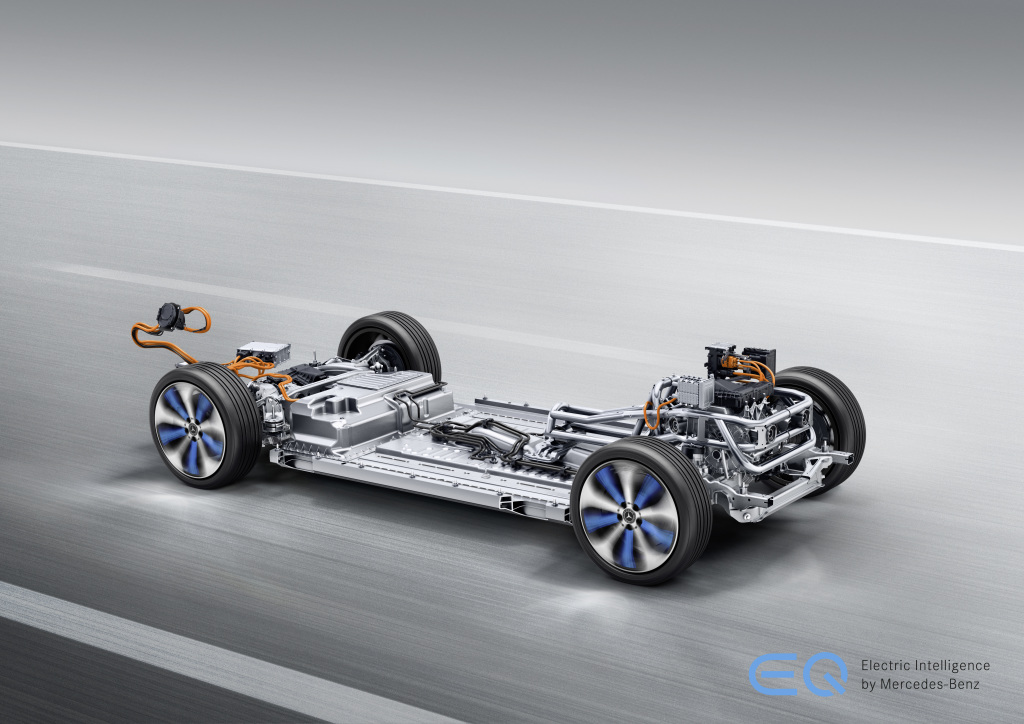
Der Mercedes-Benz EQC trägt an Vorder- und Hinterachse je einen kompakten elektrischen Antriebsstrang (eATS) und hat damit die Fahreigenschaften eines Allradantriebs. Die intelligente Steuerung erlaubt über einen weiten Betriebsbereich eine dynamische Momentenverteilung zwischen den beiden angetriebenen Achsen und schafft so die Voraussetzungen für hohe Fahrdynamik. Kernstück des Mercedes-Benz EQC ist die im Fahrzeugboden angeordnete Lithium-Ionen-Batterie aus eigener Produktion.;Stromverbrauch kombiniert: 22,2 kWh/100 km; CO2 Emissionen kombiniert: 0 g/km*, Angaben vorläufig
The EQC has a compact electric powerpack at each axle, giving the vehicle the driving characteristics of an all-wheel drive. Over a wide operating range, the intelligent control allows dynamic torque distribution between the two driven axles, creating the conditions for high vehicle dynamics. The centrepiece of the Mercedes-Benz EQC is the lithium-ion battery from in-house production housed in the vehicle floor.;combined power consumption: 22.2 kWh/100 km; combined CO2 emissions: 0 g/km*, provisional figures

Der Mercedes-Benz EQC trägt an Vorder- und Hinterachse je einen kompakten elektrischen Antriebsstrang (eATS) und hat damit die Fahreigenschaften eines Allradantriebs. Die intelligente Steuerung erlaubt über einen weiten Betriebsbereich eine dynamische Momentenverteilung zwischen den beiden angetriebenen Achsen und schafft so die Voraussetzungen für hohe Fahrdynamik. Kernstück des Mercedes-Benz EQC ist die im Fahrzeugboden angeordnete Lithium-Ionen-Batterie aus eigener Produktion.;Stromverbrauch kombiniert: 22,2 kWh/100 km; CO2 Emissionen kombiniert: 0 g/km*, Angaben vorläufig
The EQC has a compact electric powerpack at each axle, giving the vehicle the driving characteristics of an all-wheel drive. Over a wide operating range, the intelligent control allows dynamic torque distribution between the two driven axles, creating the conditions for high vehicle dynamics. The centrepiece of the Mercedes-Benz EQC is the lithium-ion battery from in-house production housed in the vehicle floor.;combined power consumption: 22.2 kWh/100 km; combined CO2 emissions: 0 g/km*, provisional figures

Der Mercedes-Benz EQC trägt an Vorder- und Hinterachse je einen kompakten elektrischen Antriebsstrang (eATS) und hat damit die Fahreigenschaften eines Allradantriebs. Die intelligente Steuerung erlaubt über einen weiten Betriebsbereich eine dynamische Momentenverteilung zwischen den beiden angetriebenen Achsen und schafft so die Voraussetzungen für hohe Fahrdynamik. Kernstück des Mercedes-Benz EQC ist die im Fahrzeugboden angeordnete Lithium-Ionen-Batterie aus eigener Produktion.;Stromverbrauch kombiniert: 22,2 kWh/100 km; CO2 Emissionen kombiniert: 0 g/km*, Angaben vorläufig
The EQC has a compact electric powerpack at each axle, giving the vehicle the driving characteristics of an all-wheel drive. Over a wide operating range, the intelligent control allows dynamic torque distribution between the two driven axles, creating the conditions for high vehicle dynamics. The centrepiece of the Mercedes-Benz EQC is the lithium-ion battery from in-house production housed in the vehicle floor.;combined power consumption: 22.2 kWh/100 km; combined CO2 emissions: 0 g/km*, provisional figures

Der Mercedes-Benz EQC trägt an Vorder- und Hinterachse je einen kompakten elektrischen Antriebsstrang (eATS) und hat damit die Fahreigenschaften eines Allradantriebs. Die intelligente Steuerung erlaubt über einen weiten Betriebsbereich eine dynamische Momentenverteilung zwischen den beiden angetriebenen Achsen und schafft so die Voraussetzungen für hohe Fahrdynamik. Kernstück des Mercedes-Benz EQC ist die im Fahrzeugboden angeordnete Lithium-Ionen-Batterie aus eigener Produktion.;Stromverbrauch kombiniert: 22,2 kWh/100 km; CO2 Emissionen kombiniert: 0 g/km*, Angaben vorläufig
The EQC has a compact electric powerpack at each axle, giving the vehicle the driving characteristics of an all-wheel drive. Over a wide operating range, the intelligent control allows dynamic torque distribution between the two driven axles, creating the conditions for high vehicle dynamics. The centrepiece of the Mercedes-Benz EQC is the lithium-ion battery from in-house production housed in the vehicle floor.;combined power consumption: 22.2 kWh/100 km; combined CO2 emissions: 0 g/km*, provisional figures

Der Mercedes-Benz EQC trägt an Vorder- und Hinterachse je einen kompakten elektrischen Antriebsstrang (eATS) und hat damit die Fahreigenschaften eines Allradantriebs. Die intelligente Steuerung erlaubt über einen weiten Betriebsbereich eine dynamische Momentenverteilung zwischen den beiden angetriebenen Achsen und schafft so die Voraussetzungen für hohe Fahrdynamik. Kernstück des Mercedes-Benz EQC ist die im Fahrzeugboden angeordnete Lithium-Ionen-Batterie aus eigener Produktion.;Stromverbrauch kombiniert: 22,2 kWh/100 km; CO2 Emissionen kombiniert: 0 g/km*, Angaben vorläufig
The EQC has a compact electric powerpack at each axle, giving the vehicle the driving characteristics of an all-wheel drive. Over a wide operating range, the intelligent control allows dynamic torque distribution between the two driven axles, creating the conditions for high vehicle dynamics. The centrepiece of the Mercedes-Benz EQC is the lithium-ion battery from in-house production housed in the vehicle floor.;combined power consumption: 22.2 kWh/100 km; combined CO2 emissions: 0 g/km*, provisional figures

Der Mercedes-Benz EQC trägt an Vorder- und Hinterachse je einen kompakten elektrischen Antriebsstrang (eATS) und hat damit die Fahreigenschaften eines Allradantriebs. Die intelligente Steuerung erlaubt über einen weiten Betriebsbereich eine dynamische Momentenverteilung zwischen den beiden angetriebenen Achsen und schafft so die Voraussetzungen für hohe Fahrdynamik. Kernstück des Mercedes-Benz EQC ist die im Fahrzeugboden angeordnete Lithium-Ionen-Batterie aus eigener Produktion.;Stromverbrauch kombiniert: 22,2 kWh/100 km; CO2 Emissionen kombiniert: 0 g/km*, Angaben vorläufig
The EQC has a compact electric powerpack at each axle, giving the vehicle the driving characteristics of an all-wheel drive. Over a wide operating range, the intelligent control allows dynamic torque distribution between the two driven axles, creating the conditions for high vehicle dynamics. The centrepiece of the Mercedes-Benz EQC is the lithium-ion battery from in-house production housed in the vehicle floor.;combined power consumption: 22.2 kWh/100 km; combined CO2 emissions: 0 g/km*, provisional figures

Der Mercedes-Benz EQC trägt an Vorder- und Hinterachse je einen kompakten elektrischen Antriebsstrang (eATS) und hat damit die Fahreigenschaften eines Allradantriebs. Die intelligente Steuerung erlaubt über einen weiten Betriebsbereich eine dynamische Momentenverteilung zwischen den beiden angetriebenen Achsen und schafft so die Voraussetzungen für hohe Fahrdynamik. Kernstück des Mercedes-Benz EQC ist die im Fahrzeugboden angeordnete Lithium-Ionen-Batterie aus eigener Produktion.;Stromverbrauch kombiniert: 22,2 kWh/100 km; CO2 Emissionen kombiniert: 0 g/km*, Angaben vorläufig
The EQC has a compact electric powerpack at each axle, giving the vehicle the driving characteristics of an all-wheel drive. Over a wide operating range, the intelligent control allows dynamic torque distribution between the two driven axles, creating the conditions for high vehicle dynamics. The centrepiece of the Mercedes-Benz EQC is the lithium-ion battery from in-house production housed in the vehicle floor.;combined power consumption: 22.2 kWh/100 km; combined CO2 emissions: 0 g/km*, provisional figures

Der Mercedes-Benz EQC trägt an Vorder- und Hinterachse je einen kompakten elektrischen Antriebsstrang (eATS) und hat damit die Fahreigenschaften eines Allradantriebs. Die intelligente Steuerung erlaubt über einen weiten Betriebsbereich eine dynamische Momentenverteilung zwischen den beiden angetriebenen Achsen und schafft so die Voraussetzungen für hohe Fahrdynamik. Kernstück des Mercedes-Benz EQC ist die im Fahrzeugboden angeordnete Lithium-Ionen-Batterie aus eigener Produktion.;Stromverbrauch kombiniert: 22,2 kWh/100 km; CO2 Emissionen kombiniert: 0 g/km*, Angaben vorläufig
The EQC has a compact electric powerpack at each axle, giving the vehicle the driving characteristics of an all-wheel drive. Over a wide operating range, the intelligent control allows dynamic torque distribution between the two driven axles, creating the conditions for high vehicle dynamics. The centrepiece of the Mercedes-Benz EQC is the lithium-ion battery from in-house production housed in the vehicle floor.;combined power consumption: 22.2 kWh/100 km; combined CO2 emissions: 0 g/km*, provisional figures

Der Mercedes-Benz EQC trägt an Vorder- und Hinterachse je einen kompakten elektrischen Antriebsstrang (eATS) und hat damit die Fahreigenschaften eines Allradantriebs. Die intelligente Steuerung erlaubt über einen weiten Betriebsbereich eine dynamische Momentenverteilung zwischen den beiden angetriebenen Achsen und schafft so die Voraussetzungen für hohe Fahrdynamik. Kernstück des Mercedes-Benz EQC ist die im Fahrzeugboden angeordnete Lithium-Ionen-Batterie aus eigener Produktion.;Stromverbrauch kombiniert: 22,2 kWh/100 km; CO2 Emissionen kombiniert: 0 g/km*, Angaben vorläufig
The EQC has a compact electric powerpack at each axle, giving the vehicle the driving characteristics of an all-wheel drive. Over a wide operating range, the intelligent control allows dynamic torque distribution between the two driven axles, creating the conditions for high vehicle dynamics. The centrepiece of the Mercedes-Benz EQC is the lithium-ion battery from in-house production housed in the vehicle floor.;combined power consumption: 22.2 kWh/100 km; combined CO2 emissions: 0 g/km*, provisional figures

Der Mercedes-Benz EQC trägt an Vorder- und Hinterachse je einen kompakten elektrischen Antriebsstrang (eATS) und hat damit die Fahreigenschaften eines Allradantriebs. Die intelligente Steuerung erlaubt über einen weiten Betriebsbereich eine dynamische Momentenverteilung zwischen den beiden angetriebenen Achsen und schafft so die Voraussetzungen für hohe Fahrdynamik. Kernstück des Mercedes-Benz EQC ist die im Fahrzeugboden angeordnete Lithium-Ionen-Batterie aus eigener Produktion.;Stromverbrauch kombiniert: 22,2 kWh/100 km; CO2 Emissionen kombiniert: 0 g/km*, Angaben vorläufig
The EQC has a compact electric powerpack at each axle, giving the vehicle the driving characteristics of an all-wheel drive. Over a wide operating range, the intelligent control allows dynamic torque distribution between the two driven axles, creating the conditions for high vehicle dynamics. The centrepiece of the Mercedes-Benz EQC is the lithium-ion battery from in-house production housed in the vehicle floor.;combined power consumption: 22.2 kWh/100 km; combined CO2 emissions: 0 g/km*, provisional figures

Der Mercedes-Benz EQC trägt an Vorder- und Hinterachse je einen kompakten elektrischen Antriebsstrang (eATS) und hat damit die Fahreigenschaften eines Allradantriebs. Die intelligente Steuerung erlaubt über einen weiten Betriebsbereich eine dynamische Momentenverteilung zwischen den beiden angetriebenen Achsen und schafft so die Voraussetzungen für hohe Fahrdynamik. Kernstück des Mercedes-Benz EQC ist die im Fahrzeugboden angeordnete Lithium-Ionen-Batterie aus eigener Produktion.;Stromverbrauch kombiniert: 22,2 kWh/100 km; CO2 Emissionen kombiniert: 0 g/km*, Angaben vorläufig
The EQC has a compact electric powerpack at each axle, giving the vehicle the driving characteristics of an all-wheel drive. Over a wide operating range, the intelligent control allows dynamic torque distribution between the two driven axles, creating the conditions for high vehicle dynamics. The centrepiece of the Mercedes-Benz EQC is the lithium-ion battery from in-house production housed in the vehicle floor.;combined power consumption: 22.2 kWh/100 km; combined CO2 emissions: 0 g/km*, provisional figures

Der Mercedes-Benz EQC trägt an Vorder- und Hinterachse je einen kompakten elektrischen Antriebsstrang (eATS) und hat damit die Fahreigenschaften eines Allradantriebs. Die intelligente Steuerung erlaubt über einen weiten Betriebsbereich eine dynamische Momentenverteilung zwischen den beiden angetriebenen Achsen und schafft so die Voraussetzungen für hohe Fahrdynamik. Kernstück des Mercedes-Benz EQC ist die im Fahrzeugboden angeordnete Lithium-Ionen-Batterie aus eigener Produktion.;Stromverbrauch kombiniert: 22,2 kWh/100 km; CO2 Emissionen kombiniert: 0 g/km*, Angaben vorläufig
The EQC has a compact electric powerpack at each axle, giving the vehicle the driving characteristics of an all-wheel drive. Over a wide operating range, the intelligent control allows dynamic torque distribution between the two driven axles, creating the conditions for high vehicle dynamics. The centrepiece of the Mercedes-Benz EQC is the lithium-ion battery from in-house production housed in the vehicle floor.;combined power consumption: 22.2 kWh/100 km; combined CO2 emissions: 0 g/km*, provisional figures

Der Mercedes-Benz EQC trägt an Vorder- und Hinterachse je einen kompakten elektrischen Antriebsstrang (eATS) und hat damit die Fahreigenschaften eines Allradantriebs. Die intelligente Steuerung erlaubt über einen weiten Betriebsbereich eine dynamische Momentenverteilung zwischen den beiden angetriebenen Achsen und schafft so die Voraussetzungen für hohe Fahrdynamik. Kernstück des Mercedes-Benz EQC ist die im Fahrzeugboden angeordnete Lithium-Ionen-Batterie aus eigener Produktion.;Stromverbrauch kombiniert: 22,2 kWh/100 km; CO2 Emissionen kombiniert: 0 g/km*, Angaben vorläufig
The EQC has a compact electric powerpack at each axle, giving the vehicle the driving characteristics of an all-wheel drive. Over a wide operating range, the intelligent control allows dynamic torque distribution between the two driven axles, creating the conditions for high vehicle dynamics. The centrepiece of the Mercedes-Benz EQC is the lithium-ion battery from in-house production housed in the vehicle floor.;combined power consumption: 22.2 kWh/100 km; combined CO2 emissions: 0 g/km*, provisional figures

Der Mercedes-Benz EQC trägt an Vorder- und Hinterachse je einen kompakten elektrischen Antriebsstrang (eATS) und hat damit die Fahreigenschaften eines Allradantriebs. Die intelligente Steuerung erlaubt über einen weiten Betriebsbereich eine dynamische Momentenverteilung zwischen den beiden angetriebenen Achsen und schafft so die Voraussetzungen für hohe Fahrdynamik. Kernstück des Mercedes-Benz EQC ist die im Fahrzeugboden angeordnete Lithium-Ionen-Batterie aus eigener Produktion.;Stromverbrauch kombiniert: 22,2 kWh/100 km; CO2 Emissionen kombiniert: 0 g/km*, Angaben vorläufig
The EQC has a compact electric powerpack at each axle, giving the vehicle the driving characteristics of an all-wheel drive. Over a wide operating range, the intelligent control allows dynamic torque distribution between the two driven axles, creating the conditions for high vehicle dynamics. The centrepiece of the Mercedes-Benz EQC is the lithium-ion battery from in-house production housed in the vehicle floor.;combined power consumption: 22.2 kWh/100 km; combined CO2 emissions: 0 g/km*, provisional figures

Der Mercedes-Benz EQC trägt an Vorder- und Hinterachse je einen kompakten elektrischen Antriebsstrang (eATS) und hat damit die Fahreigenschaften eines Allradantriebs. Die intelligente Steuerung erlaubt über einen weiten Betriebsbereich eine dynamische Momentenverteilung zwischen den beiden angetriebenen Achsen und schafft so die Voraussetzungen für hohe Fahrdynamik. Kernstück des Mercedes-Benz EQC ist die im Fahrzeugboden angeordnete Lithium-Ionen-Batterie aus eigener Produktion.;Stromverbrauch kombiniert: 22,2 kWh/100 km; CO2 Emissionen kombiniert: 0 g/km*, Angaben vorläufig
The EQC has a compact electric powerpack at each axle, giving the vehicle the driving characteristics of an all-wheel drive. Over a wide operating range, the intelligent control allows dynamic torque distribution between the two driven axles, creating the conditions for high vehicle dynamics. The centrepiece of the Mercedes-Benz EQC is the lithium-ion battery from in-house production housed in the vehicle floor.;combined power consumption: 22.2 kWh/100 km; combined CO2 emissions: 0 g/km*, provisional figures

Der Mercedes-Benz EQC trägt an Vorder- und Hinterachse je einen kompakten elektrischen Antriebsstrang (eATS) und hat damit die Fahreigenschaften eines Allradantriebs. Die intelligente Steuerung erlaubt über einen weiten Betriebsbereich eine dynamische Momentenverteilung zwischen den beiden angetriebenen Achsen und schafft so die Voraussetzungen für hohe Fahrdynamik. Kernstück des Mercedes-Benz EQC ist die im Fahrzeugboden angeordnete Lithium-Ionen-Batterie aus eigener Produktion.;Stromverbrauch kombiniert: 22,2 kWh/100 km; CO2 Emissionen kombiniert: 0 g/km*, Angaben vorläufig
The EQC has a compact electric powerpack at each axle, giving the vehicle the driving characteristics of an all-wheel drive. Over a wide operating range, the intelligent control allows dynamic torque distribution between the two driven axles, creating the conditions for high vehicle dynamics. The centrepiece of the Mercedes-Benz EQC is the lithium-ion battery from in-house production housed in the vehicle floor.;combined power consumption: 22.2 kWh/100 km; combined CO2 emissions: 0 g/km*, provisional figures

Der Mercedes-Benz EQC trägt an Vorder- und Hinterachse je einen kompakten elektrischen Antriebsstrang (eATS) und hat damit die Fahreigenschaften eines Allradantriebs. Die intelligente Steuerung erlaubt über einen weiten Betriebsbereich eine dynamische Momentenverteilung zwischen den beiden angetriebenen Achsen und schafft so die Voraussetzungen für hohe Fahrdynamik. Kernstück des Mercedes-Benz EQC ist die im Fahrzeugboden angeordnete Lithium-Ionen-Batterie aus eigener Produktion.;Stromverbrauch kombiniert: 22,2 kWh/100 km; CO2 Emissionen kombiniert: 0 g/km*, Angaben vorläufig
The EQC has a compact electric powerpack at each axle, giving the vehicle the driving characteristics of an all-wheel drive. Over a wide operating range, the intelligent control allows dynamic torque distribution between the two driven axles, creating the conditions for high vehicle dynamics. The centrepiece of the Mercedes-Benz EQC is the lithium-ion battery from in-house production housed in the vehicle floor.;combined power consumption: 22.2 kWh/100 km; combined CO2 emissions: 0 g/km*, provisional figures

Der Mercedes-Benz EQC trägt an Vorder- und Hinterachse je einen kompakten elektrischen Antriebsstrang (eATS) und hat damit die Fahreigenschaften eines Allradantriebs. Die intelligente Steuerung erlaubt über einen weiten Betriebsbereich eine dynamische Momentenverteilung zwischen den beiden angetriebenen Achsen und schafft so die Voraussetzungen für hohe Fahrdynamik. Kernstück des Mercedes-Benz EQC ist die im Fahrzeugboden angeordnete Lithium-Ionen-Batterie aus eigener Produktion.;Stromverbrauch kombiniert: 22,2 kWh/100 km; CO2 Emissionen kombiniert: 0 g/km*, Angaben vorläufig
The EQC has a compact electric powerpack at each axle, giving the vehicle the driving characteristics of an all-wheel drive. Over a wide operating range, the intelligent control allows dynamic torque distribution between the two driven axles, creating the conditions for high vehicle dynamics. The centrepiece of the Mercedes-Benz EQC is the lithium-ion battery from in-house production housed in the vehicle floor.;combined power consumption: 22.2 kWh/100 km; combined CO2 emissions: 0 g/km*, provisional figures

Der Mercedes-Benz EQC trägt an Vorder- und Hinterachse je einen kompakten elektrischen Antriebsstrang (eATS) und hat damit die Fahreigenschaften eines Allradantriebs. Die intelligente Steuerung erlaubt über einen weiten Betriebsbereich eine dynamische Momentenverteilung zwischen den beiden angetriebenen Achsen und schafft so die Voraussetzungen für hohe Fahrdynamik. Kernstück des Mercedes-Benz EQC ist die im Fahrzeugboden angeordnete Lithium-Ionen-Batterie aus eigener Produktion.;Stromverbrauch kombiniert: 22,2 kWh/100 km; CO2 Emissionen kombiniert: 0 g/km, Angaben vorläufig*
The EQC has a compact electric powerpack at each axle, giving the vehicle the driving characteristics of an all-wheel drive. Over a wide operating range, the intelligent control allows dynamic torque distribution between the two driven axles, creating the conditions for high vehicle dynamics. The centrepiece of the Mercedes-Benz EQC is the lithium-ion battery from in-house production housed in the vehicle floor.;combined power consumption: 22.2 kWh/100 km; combined CO2 emissions: 0 g/km, provisional figures*

Der Mercedes-Benz EQC trägt an Vorder- und Hinterachse je einen kompakten elektrischen Antriebsstrang (eATS) und hat damit die Fahreigenschaften eines Allradantriebs. Die intelligente Steuerung erlaubt über einen weiten Betriebsbereich eine dynamische Momentenverteilung zwischen den beiden angetriebenen Achsen und schafft so die Voraussetzungen für hohe Fahrdynamik. Kernstück des Mercedes-Benz EQC ist die im Fahrzeugboden angeordnete Lithium-Ionen-Batterie aus eigener Produktion.;Stromverbrauch kombiniert: 22,2 kWh/100 km; CO2 Emissionen kombiniert: 0 g/km*, Angaben vorläufig
The EQC has a compact electric powerpack at each axle, giving the vehicle the driving characteristics of an all-wheel drive. Over a wide operating range, the intelligent control allows dynamic torque distribution between the two driven axles, creating the conditions for high vehicle dynamics. The centrepiece of the Mercedes-Benz EQC is the lithium-ion battery from in-house production housed in the vehicle floor.;combined power consumption: 22.2 kWh/100 km; combined CO2 emissions: 0 g/km*, provisional figures
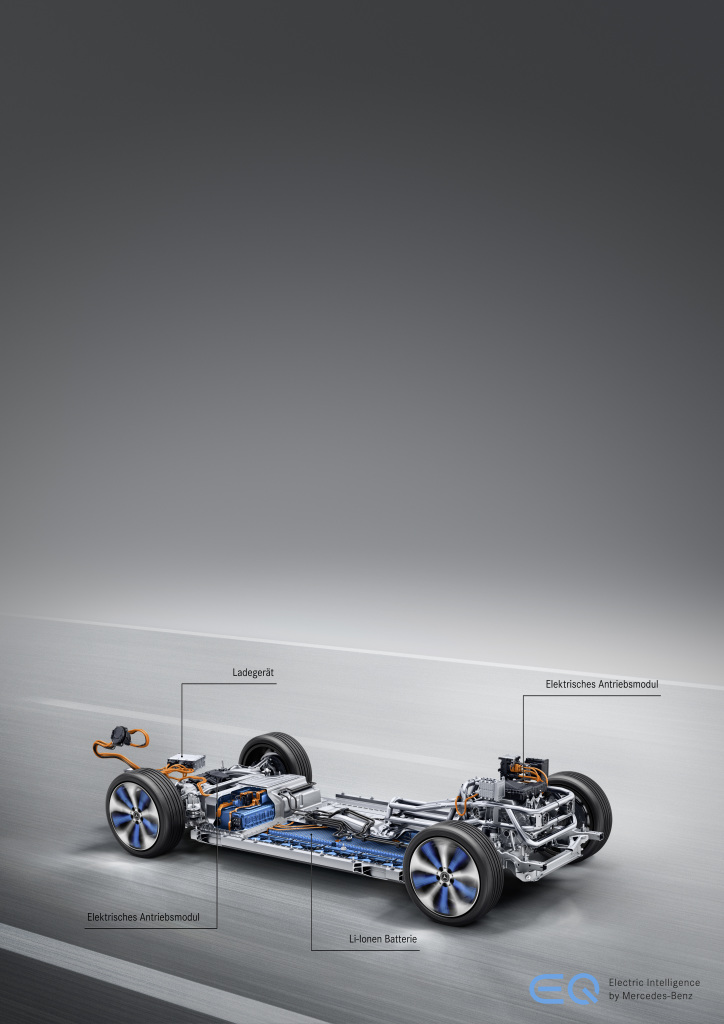
Der Mercedes-Benz EQC trägt an Vorder- und Hinterachse je einen kompakten elektrischen Antriebsstrang (eATS) und hat damit die Fahreigenschaften eines Allradantriebs. Die intelligente Steuerung erlaubt über einen weiten Betriebsbereich eine dynamische Momentenverteilung zwischen den beiden angetriebenen Achsen und schafft so die Voraussetzungen für hohe Fahrdynamik. Kernstück des Mercedes-Benz EQC ist die im Fahrzeugboden angeordnete Lithium-Ionen-Batterie aus eigener Produktion.;Stromverbrauch kombiniert: 22,2 kWh/100 km; CO2 Emissionen kombiniert: 0 g/km*, Angaben vorläufig
The EQC has a compact electric powerpack at each axle, giving the vehicle the driving characteristics of an all-wheel drive. Over a wide operating range, the intelligent control allows dynamic torque distribution between the two driven axles, creating the conditions for high vehicle dynamics. The centrepiece of the Mercedes-Benz EQC is the lithium-ion battery from in-house production housed in the vehicle floor.;combined power consumption: 22.2 kWh/100 km; combined CO2 emissions: 0 g/km*, provisional figures

Der Mercedes-Benz EQC ist mit der neusten Generation einer Lithium-Ionen-Batterie (Li-Ion) ausgerüstet. Das Systemdesign der Batterie ist modular aufgebaut, es besteht aus zwei Modulen mit jeweils 48 und vier Modulen mit 72 Zellen.;Stromverbrauch kombiniert: 22,2 kWh/100 km; CO2 Emissionen kombiniert: 0 g/km, Angaben vorläufig*
The Mercedes-Benz EQC is equipped with the latest generation of a lithium-ion (Li-Ion) battery. The battery system is modular in design, consisting of two modules with 48 cells each and four with 72 cells each. ;combined power consumption: 22.2 kWh/100 km; combined CO2 emissions: 0 g/km, provisional figures*

Der Mercedes-Benz EQC ist mit der neusten Generation einer Lithium-Ionen-Batterie (Li-Ion) ausgerüstet. Das Systemdesign der Batterie ist modular aufgebaut, es besteht aus zwei Modulen mit jeweils 48 und vier Modulen mit 72 Zellen.;Stromverbrauch kombiniert: 22,2 kWh/100 km; CO2 Emissionen kombiniert: 0 g/km*, Angaben vorläufig
The Mercedes-Benz EQC is equipped with the latest generation of a lithium-ion (Li-Ion) battery. The battery system is modular in design, consisting of two modules with 48 cells each and four with 72 cells each.;combined power consumption: 22.2 kWh/100 km; combined CO2 emissions: 0 g/km*, provisional figures

Der Mercedes-Benz EQC ist mit der neusten Generation einer Lithium-Ionen-Batterie (Li-Ion) ausgerüstet. Das Systemdesign der Batterie ist modular aufgebaut, es besteht aus zwei Modulen mit jeweils 48 und vier Modulen mit 72 Zellen.;Stromverbrauch kombiniert: 22,2 kWh/100 km; CO2 Emissionen kombiniert: 0 g/km*, Angaben vorläufig
The Mercedes-Benz EQC is equipped with the latest generation of a lithium-ion (Li-Ion) battery. The battery system is modular in design, consisting of two modules with 48 cells each and four with 72 cells each.;combined power consumption: 22.2 kWh/100 km; combined CO2 emissions: 0 g/km*, provisional figures

Der neue Mercedes-Benz ECQ; Vorserienproduktion der EQC-Batterie;Stromverbrauch kombiniert: 22,2 kWh/100 km; CO2 Emissionen kombiniert: 0 g/km*, Angaben vorläufig
The new Mercedes-Benz EQC; Preseries production of EQC battery;combined power consumption: 22.2 kWh/100 km; combined CO2 emissions: 0 g/km*, provisional figures

Der neue Mercedes-Benz ECQ; Vorserienproduktion der EQC-Batterie;Stromverbrauch kombiniert: 22,2 kWh/100 km; CO2 Emissionen kombiniert: 0 g/km*, Angaben vorläufig
The new Mercedes-Benz EQC; Preseries production of EQC battery;combined power consumption: 22.2 kWh/100 km; combined CO2 emissions: 0 g/km*, provisional figures

Der neue Mercedes-Benz ECQ; Vorserienproduktion der EQC-Batterie;Stromverbrauch kombiniert: 22,2 kWh/100 km; CO2 Emissionen kombiniert: 0 g/km*, Angaben vorläufig
The new Mercedes-Benz EQC; Preseries production of EQC battery;combined power consumption: 22.2 kWh/100 km; combined CO2 emissions: 0 g/km*, provisional figures

Der neue Mercedes-Benz ECQ; Vorserienproduktion der EQC-Batterie;Stromverbrauch kombiniert: 22,2 kWh/100 km; CO2 Emissionen kombiniert: 0 g/km*, Angaben vorläufig
The new Mercedes-Benz EQC; Preseries production of EQC battery;combined power consumption: 22.2 kWh/100 km; combined CO2 emissions: 0 g/km*, provisional figures

Der neue Mercedes-Benz ECQ; Vorserienproduktion der EQC-Batterie;Stromverbrauch kombiniert: 22,2 kWh/100 km; CO2 Emissionen kombiniert: 0 g/km*, Angaben vorläufig
The new Mercedes-Benz EQC; Preseries production of EQC battery;combined power consumption: 22.2 kWh/100 km; combined CO2 emissions: 0 g/km*, provisional figures

Der neue Mercedes-Benz ECQ; Vorserienproduktion der EQC-Batterie;Stromverbrauch kombiniert: 22,2 kWh/100 km; CO2 Emissionen kombiniert: 0 g/km*, Angaben vorläufig
The new Mercedes-Benz EQC; Preseries production of EQC battery;combined power consumption: 22.2 kWh/100 km; combined CO2 emissions: 0 g/km*, provisional figures

Der neue Mercedes-Benz ECQ; Vorserienproduktion der EQC-Batterie;Stromverbrauch kombiniert: 22,2 kWh/100 km; CO2 Emissionen kombiniert: 0 g/km*, Angaben vorläufig
The new Mercedes-Benz EQC; Preseries production of EQC battery;combined power consumption: 22.2 kWh/100 km; combined CO2 emissions: 0 g/km*, provisional figures

Mercedes-Benz EQC 400 4MATIC, (BR N293) / designo Diamantweiß bright / Exterior: AMG Line / Interior: AMG Line / Der neue Mercedes-Benz EQC – der erste Mercedes-Benz der Produkt- und Technologiemarke EQ. Mit seinem nahtlosen klaren Design ist der EQC ein Vorreiter einer avantgardistischen Elektro-Ästhetik mit wegweisenden Designdetails und markentypischen Farbakzenten außen wie innen.;Stromverbrauch kombiniert: 22,2 kWh/100 km; CO2 Emissionen kombiniert: 0 g/km*, Angaben vorläufig
Mercedes-Benz EQC 400 4MATIC, (BR N293) / designo diamond white bright / Exterior: AMG Line / Interior: AMG Line / The new Mercedes-Benz EQC – the first Mercedes-Benz under the product and technology brand EQ. With its seamless, clear design, the EQC is a pioneer for an avant-garde electric look with trailblazing design details and colour highlights typical of the brand both inside and out.;combined power consumption: 22.2 kWh/100 km; combined CO2 emissions: 0 g/km*, provisional figures

Mercedes-Benz EQC 400 4MATIC, (BR N293) / designo Diamantweiß bright / Exterior: AMG Line / Interior: AMG Line / Der neue Mercedes-Benz EQC – der erste Mercedes-Benz der Produkt- und Technologiemarke EQ. Mit seinem nahtlosen klaren Design ist der EQC ein Vorreiter einer avantgardistischen Elektro-Ästhetik mit wegweisenden Designdetails und markentypischen Farbakzenten außen wie innen. / In Europa gibt es weit über 200 verschiedene Betreiber von Ladestationen an öffentlichen Plätzen. Mercedes me Charge ermöglicht auch den Zugang zu den Schnellladestationen des paneuropäischen Schnellladenetzes von IONITY. Die kurzen Ladezeiten sorgen insbesondere bei Langstrecken für eine angenehme Reise. Entlang der Hauptverkehrsachsen in Europa wird IONITY bis 2020 insgesamt rund 400 Schnellladestationen errichten und betreiben.;Stromverbrauch kombiniert: 22,2 kWh/100 km; CO2 Emissionen kombiniert: 0 g/km*, Angaben vorläufig
Mercedes-Benz EQC 400 4MATIC, (BR N293) / designo diamond white bright / Exterior: AMG Line / Interior: AMG Line / The new Mercedes-Benz EQC – the first Mercedes-Benz under the product and technology brand EQ. With its seamless, clear design, the EQC is a pioneer for an avant-garde electric look with trailblazing design details and colour highlights typical of the brand both inside and out. / There are well over 200 operators of charging stations in public places in Europe. Mercedes me Charge also allows access to the quick-charging stations of the pan-European network IONITY. Especially over long distances, the short charging times make for a pleasant journey. By 2020 IONITY will construct and operate around 400 quick stations along the main traffic arteries in Europe.;combined power consumption: 22.2 kWh/100 km; combined CO2 emissions: 0 g/km*, provisional figures

Mercedes-Benz EQC 400 4MATIC, (BR N293) / designo Diamantweiß bright / Exterior: AMG Line / Interior: AMG Line / Der neue Mercedes-Benz EQC – der erste Mercedes-Benz der Produkt- und Technologiemarke EQ. Mit seinem nahtlosen klaren Design ist der EQC ein Vorreiter einer avantgardistischen Elektro-Ästhetik mit wegweisenden Designdetails und markentypischen Farbakzenten außen wie innen. / In Europa gibt es weit über 200 verschiedene Betreiber von Ladestationen an öffentlichen Plätzen. Mercedes me Charge ermöglicht auch den Zugang zu den Schnellladestationen des paneuropäischen Schnellladenetzes von IONITY. Die kurzen Ladezeiten sorgen insbesondere bei Langstrecken für eine angenehme Reise. Entlang der Hauptverkehrsachsen in Europa wird IONITY bis 2020 insgesamt rund 400 Schnellladestationen errichten und betreiben.;Stromverbrauch kombiniert: 22,2 kWh/100 km; CO2 Emissionen kombiniert: 0 g/km*, Angaben vorläufig
Mercedes-Benz EQC 400 4MATIC, (BR N293) / designo diamond white bright / Exterior: AMG Line / Interior: AMG Line / The new Mercedes-Benz EQC – the first Mercedes-Benz under the product and technology brand EQ. With its seamless, clear design, the EQC is a pioneer for an avant-garde electric look with trailblazing design details and colour highlights typical of the brand both inside and out. / There are well over 200 operators of charging stations in public places in Europe. Mercedes me Charge also allows access to the quick-charging stations of the pan-European network IONITY. Especially over long distances, the short charging times make for a pleasant journey. By 2020 IONITY will construct and operate around 400 quick stations along the main traffic arteries in Europe.;combined power consumption: 22.2 kWh/100 km; combined CO2 emissions: 0 g/km*, provisional figures

Mercedes-Benz EQC 400 4MATIC, (BR N293) / designo Diamantweiß bright / Exterior: AMG Line / Interior: AMG Line / Der neue Mercedes-Benz EQC – der erste Mercedes-Benz der Produkt- und Technologiemarke EQ. Mit seinem nahtlosen klaren Design ist der EQC ein Vorreiter einer avantgardistischen Elektro-Ästhetik mit wegweisenden Designdetails und markentypischen Farbakzenten außen wie innen. / In Europa gibt es weit über 200 verschiedene Betreiber von Ladestationen an öffentlichen Plätzen. Mercedes me Charge ermöglicht auch den Zugang zu den Schnellladestationen des paneuropäischen Schnellladenetzes von IONITY. Die kurzen Ladezeiten sorgen insbesondere bei Langstrecken für eine angenehme Reise. Entlang der Hauptverkehrsachsen in Europa wird IONITY bis 2020 insgesamt rund 400 Schnellladestationen errichten und betreiben.;Stromverbrauch kombiniert: 22,2 kWh/100 km; CO2 Emissionen kombiniert: 0 g/km*, Angaben vorläufig
Mercedes-Benz EQC 400 4MATIC, (BR N293) / designo diamond white bright / Exterior: AMG Line / Interior: AMG Line / The new Mercedes-Benz EQC – the first Mercedes-Benz under the product and technology brand EQ. With its seamless, clear design, the EQC is a pioneer for an avant-garde electric look with trailblazing design details and colour highlights typical of the brand both inside and out. / There are well over 200 operators of charging stations in public places in Europe. Mercedes me Charge also allows access to the quick-charging stations of the pan-European network IONITY. Especially over long distances, the short charging times make for a pleasant journey. By 2020 IONITY will construct and operate around 400 quick stations along the main traffic arteries in Europe.;combined power consumption: 22.2 kWh/100 km; combined CO2 emissions: 0 g/km*, provisional figures

Mercedes-Benz EQC 400 4MATIC, (BR N293) / designo Diamantweiß bright / Exterior: AMG Line / Interior: AMG Line / Der neue Mercedes-Benz EQC – der erste Mercedes-Benz der Produkt- und Technologiemarke EQ. Mit seinem nahtlosen klaren Design ist der EQC ein Vorreiter einer avantgardistischen Elektro-Ästhetik mit wegweisenden Designdetails und markentypischen Farbakzenten außen wie innen. / In Europa gibt es weit über 200 verschiedene Betreiber von Ladestationen an öffentlichen Plätzen. Mercedes me Charge ermöglicht auch den Zugang zu den Schnellladestationen des paneuropäischen Schnellladenetzes von IONITY. Die kurzen Ladezeiten sorgen insbesondere bei Langstrecken für eine angenehme Reise. Entlang der Hauptverkehrsachsen in Europa wird IONITY bis 2020 insgesamt rund 400 Schnellladestationen errichten und betreiben.;Stromverbrauch kombiniert: 22,2 kWh/100 km; CO2 Emissionen kombiniert: 0 g/km*, Angaben vorläufig
Mercedes-Benz EQC 400 4MATIC, (BR N293) / designo diamond white bright / Exterior: AMG Line / Interior: AMG Line / The new Mercedes-Benz EQC – the first Mercedes-Benz under the product and technology brand EQ. With its seamless, clear design, the EQC is a pioneer for an avant-garde electric look with trailblazing design details and colour highlights typical of the brand both inside and out. / There are well over 200 operators of charging stations in public places in Europe. Mercedes me Charge also allows access to the quick-charging stations of the pan-European network IONITY. Especially over long distances, the short charging times make for a pleasant journey. By 2020 IONITY will construct and operate around 400 quick stations along the main traffic arteries in Europe.;combined power consumption: 22.2 kWh/100 km; combined CO2 emissions: 0 g/km*, provisional figures

Mercedes-Benz EQC 400 4MATIC, (BR N293) / designo Diamantweiß bright / Exterior: AMG Line / Interior: AMG Line / Der neue Mercedes-Benz EQC – der erste Mercedes-Benz der Produkt- und Technologiemarke EQ. Mit seinem nahtlosen klaren Design ist der EQC ein Vorreiter einer avantgardistischen Elektro-Ästhetik mit wegweisenden Designdetails und markentypischen Farbakzenten außen wie innen. / In Europa gibt es weit über 200 verschiedene Betreiber von Ladestationen an öffentlichen Plätzen. Mercedes me Charge ermöglicht auch den Zugang zu den Schnellladestationen des paneuropäischen Schnellladenetzes von IONITY. Die kurzen Ladezeiten sorgen insbesondere bei Langstrecken für eine angenehme Reise. Entlang der Hauptverkehrsachsen in Europa wird IONITY bis 2020 insgesamt rund 400 Schnellladestationen errichten und betreiben.;Stromverbrauch kombiniert: 22,2 kWh/100 km; CO2 Emissionen kombiniert: 0 g/km*, Angaben vorläufig
Mercedes-Benz EQC 400 4MATIC, (BR N293) / designo diamond white bright / Exterior: AMG Line / Interior: AMG Line / The new Mercedes-Benz EQC – the first Mercedes-Benz under the product and technology brand EQ. With its seamless, clear design, the EQC is a pioneer for an avant-garde electric look with trailblazing design details and colour highlights typical of the brand both inside and out. / There are well over 200 operators of charging stations in public places in Europe. Mercedes me Charge also allows access to the quick-charging stations of the pan-European network IONITY. Especially over long distances, the short charging times make for a pleasant journey. By 2020 IONITY will construct and operate around 400 quick stations along the main traffic arteries in Europe.;combined power consumption: 22.2 kWh/100 km; combined CO2 emissions: 0 g/km*, provisional figures

Mercedes-Benz EQC 400 4MATIC, (BR N293) / designo Diamantweiß bright / Exterior: AMG Line / Interior: AMG Line / Der neue Mercedes-Benz EQC – der erste Mercedes-Benz der Produkt- und Technologiemarke EQ. Mit seinem nahtlosen klaren Design ist der EQC ein Vorreiter einer avantgardistischen Elektro-Ästhetik mit wegweisenden Designdetails und markentypischen Farbakzenten außen wie innen. / In Europa gibt es weit über 200 verschiedene Betreiber von Ladestationen an öffentlichen Plätzen. Mercedes me Charge ermöglicht auch den Zugang zu den Schnellladestationen des paneuropäischen Schnellladenetzes von IONITY. Die kurzen Ladezeiten sorgen insbesondere bei Langstrecken für eine angenehme Reise. Entlang der Hauptverkehrsachsen in Europa wird IONITY bis 2020 insgesamt rund 400 Schnellladestationen errichten und betreiben.;Stromverbrauch kombiniert: 22,2 kWh/100 km; CO2 Emissionen kombiniert: 0 g/km*, Angaben vorläufig
Mercedes-Benz EQC 400 4MATIC, (BR N293) / designo diamond white bright / Exterior: AMG Line / Interior: AMG Line / The new Mercedes-Benz EQC – the first Mercedes-Benz under the product and technology brand EQ. With its seamless, clear design, the EQC is a pioneer for an avant-garde electric look with trailblazing design details and colour highlights typical of the brand both inside and out. / There are well over 200 operators of charging stations in public places in Europe. Mercedes me Charge also allows access to the quick-charging stations of the pan-European network IONITY. Especially over long distances, the short charging times make for a pleasant journey. By 2020 IONITY will construct and operate around 400 quick stations along the main traffic arteries in Europe.;combined power consumption: 22.2 kWh/100 km; combined CO2 emissions: 0 g/km*, provisional figures

Mercedes-Benz EQC 400 4MATIC, (BR N293) / designo Diamantweiß bright / Exterior: AMG Line / Interior: AMG Line / Der neue Mercedes-Benz EQC – der erste Mercedes-Benz der Produkt- und Technologiemarke EQ. Mit seinem nahtlosen klaren Design ist der EQC ein Vorreiter einer avantgardistischen Elektro-Ästhetik mit wegweisenden Designdetails und markentypischen Farbakzenten außen wie innen.;Stromverbrauch kombiniert: 22,2 kWh/100 km; CO2 Emissionen kombiniert: 0 g/km*, Angaben vorläufig
Mercedes-Benz EQC 400 4MATIC, (BR N 293) / designo diamond white bright / Exterior: AMG Line / Interior: AMG Line / The new Mercedes-Benz EQC – the first Mercedes-Benz under the product and technology brand EQ. With its seamless, clear design, the EQC is a pioneer for an avant-garde electric look with trailblazing design details and colour highlights typical of the brand both inside and out.;combined power consumption: 22.2 kWh/100 km; combined CO2 emissions: 0 g/km*, provisional figures
The New Mercedes-Benz EQC – Highlights
It was at the 2016 Paris Motor Show that Mercedes‑Benz first presented its new product and technology brand for electromobility
It was at the 2016 Paris Motor Show that Mercedes‑Benz first presented its new product and technology brand for electromobility. In mid-2019 the time has now come: The EQC (combined power consumption: 22.2 kWh/100 km; combined CO2 emissions: 0 g/km, provisional figures)1 is the first Mercedes-Benz vehicle to be launched under the EQ brand. With its seamless, clear design and colour highlights typical of the brand, it is a pioneer for an avant-garde electric look while representing the design idiom of Progressive Luxury. With respect to quality, safety and comfort the EQC is the Mercedes-Benz among electric vehicles, and highly convincing in the sum of its attributes. These are accompanied by dynamic performance, thanks to two electric motors at the front and rear axles with a combined output of 300 kW. A sophisticated operating strategy enables an electric range of more than 450 km according to NEDC (provisional figure)1. EQ also offers comprehensive services with Mercedes me, and makes electromobility convenient and suitable for day-to-day motoring. The EQC also symbolises the start of a new mobility era at Daimler.

Mercedes-Benz EQC 400 4MATIC, (BR N293) / hightech silver / Interior: Electric Art / The new Mercedes-Benz EQC – the first Mercedes-Benz under the product and technology brand EQ. With its seamless, clear design, the EQC is a pioneer for an avant-garde electric look with trailblazing design details and colour highlights typical of the brand both inside and out.;combined power consumption: 22.2 kWh/100 km; combined CO2 emissions: 0 g/km*, provisional figures
… the first Mercedes-Benz under the product and technology brand EQ
- EQ stands for “Electric Intelligence”
- It is derived from the Mercedes-Benz brand values of “Emotion” and “Intelligence”
- The EQC (combined power consumption: 22.2 kWh/100 km; combined CO2 emissions: 0 g/km, provisional figures)1 is part of a growing family of all-electric vehicles from Mercedes-Benz
- Conceived to meet all the requirements for a battery-electric drive system
- Convincing in the sum of its attributes with respect to comfort, quality and operating range
- An electric range of more than 450 km according to NEDC (provisional figure)1
- Pioneer of an avant-garde electric look
- Progressive luxury points the way to the future
- Large black-panel surface as a striking front feature
- Optical fibres as a visual link to the torch-like daytime running lamps
- Sporty, stretched silhouette
- Innovative interior design inspired by the world of consumer electronics
- A compact electric drivetrain at each axle, with a combined output of 300 kW
- Superior driving characteristics of an all-wheel drive vehicle
- Various driving modes with different characteristics
- Battery recuperation can be adjusted as the customer requires, using gearshift paddles behind the steering wheel. In “D Auto” mode, the EQC can also adapt recuperation according to the situation with the aid of ECO Assist
… the Mercedes-Benz among electric vehicles
- Latest-generation driving assistance systems with new tailback management functions
- Extensive crash test programme
- Stringent additional requirements for the battery and all components carrying electrical current
- Pre-climatisation means no scraping ice in the winter and no perspiration in the summer
- Extremely quiet interior
- Trailblazing MBUX multimedia system – Mercedes-Benz User Experience with numerous EQ specific functions
- A trailer coupling is available on request. The maximum towing capacity (braked) is 1800 kg
- Integration into ongoing series production at the Mercedes-Benz plant in Bremen
- Battery produced by the Daimler subsidiary Deutsche Accumotive
… more than just a car, and a symbol of a new era in mobility
- Comprehensive services for the electromobility of today and tomorrow
- Relaxed, uncomplicated travel with transparency and planning certainty
- Dialogue with visionaries, business people and opinion leaders in the “EQ Community”
- New event formats “EQ Dinner” and “EQ Nights”
- Entry into Formel E for the 2019/20 season
1 Figures for power consumption and CO2 emissions are provisional and were determined by the German Technical Service corporation. The range figures are also provisional. EC type approval and conformity certification with official figures are not yet available. There may be differences between the stated figures and the official figures.
What Does it Take to Heat Test a New Electric Mercedes-Benz
Challenge number one is this: the dry heat. Because while the battery of an electric car "merely" loses power in the cold, exposure to great heat carries the risk of battery damage
Working where others take their holidays: Spain is the next stage for the Mercedes-Benz EQC on the road to series production maturity. No chance for relaxation, however: part of the heat testing for the overall vehicle takes place on the Iberian peninsula. Following successful winter trials, the EQC is required to absolve an extensive test program in the burning summer heat with temperatures of up to 50° Celsius (122 Fahrenheit). Particular attention is given to aspects which are very demanding for electric cars, i.e. air conditioning and charging, as well as cooling the battery, drive system and control units in extreme heat. Naturally classical criteria such as driving dynamics and ride comfort are also subjected to further, stringent tests.

Spain is the current stage for the Mercedes-Benz EQC on the road to series production maturity – the Mercedes-Benz heat testing. Particular attention is given to aspects which are very demanding for electric cars, i.e. air conditioning and charging, as well as cooling the battery, drive system and control units in extreme heat. Naturally classical criteria such as driving dynamics and ride comfort are also subjected to further, stringent tests.
“With the finishing straight in sight, we are now able to absolve another extremely demanding test programme with our pre-series vehicles,” says Michael Kelz, Chief Engineer for the EQC. “But after successfully completed endurance tests in winter at minus 35 degrees C (-31 F), we are confident that the heat trials will confirm that we are well on schedule for the start of series production.”
Challenge number one is this: the dry heat. Because while the battery of an electric car “merely” loses power in the cold, exposure to great heat carries the risk of battery damage. Optimum management of these physical characteristics is the aim of the extreme tests in Spain. One main focus is on the battery’s cooling circuit, for example: how does it cope with high power requirements? How does an almost fully charged battery respond to further charging? What influence does the heat have on operating range? Battery draining tests, i.e. test drives in which the battery is completely drained of power, are also part of the test programme.
Another aspect is air conditioning of the interior – both during a journey and beforehand, as pre-climatisation is an important comfort factor. This is when questions such as “Is the indicated time sufficient for pre-climatisation?” and “Is the calculated range correct when the temperature is taken into consideration?” are answered. Furthermore, the noise characteristics of individual components such as the air conditioning compressor in the heat are specifically examined.
Fine dust is also a particular challenge during the trials in Spain, as the test technicians want to know where this dust might be deposited in the components, and whether the sealing concept works in practice.
Different countries present different circumstances, a truism that plays a very important part in the Mercedes-Benz test programme. The key question is this: is the international operability of each individual system assured? A few examples: Are the slightly differently designed traffic signs recognised? Are toll stations reliably recognised? Are speed limits correctly detected by the camera of the assistance systems? All of these questions are also examined by the developers during their busy test weeks in Spain.
Demanding test programme at Mercedes-Benz
Systematic complete-vehicle validation is among the extensive measures in the development process of every Mercedes-Benz model series. This serves to verify the high quality standards.
Before a new product goes into production, the complete vehicle must reach a maturity level set by Mercedes-Benz. This takes place in several stages: step one is digital preliminary design and simulation. It is followed by validation – either of individual components on dynamometers or in test vehicles. This tests and validates, for example, the durability of a powertrain connection or of individual axle parts.
Testing: absolutely essential before the launch of a new vehicle
- Totally digital: Digital testing covers all key areas of vehicle development: from the simulation and verification of buildability to crash, aerodynamic, ride & handling), NVH (Noise, Vibration, Harshness) and weight tests plus fuel consumption and operating range.
- From computer screen to dynamometer and onto the road: Despite all the advantages of digital testing in terms of speed, data availability and efficiency – no vehicle goes into series production without extensive real-world testing. The focus is on the long-term durability of components such as major assemblies on the dynamometer, and functional testing of the complete vehicle under different climatic conditions on the roads. In the case of the EQC, of course, special attention is paid to the electric powertrain and the battery. They too are tested and approved in accordance with Mercedes-Benz’s extremely strict standards.
- One third/two thirds: With a ratio of 35% to 65% between digital testing and real-world testing, Mercedes-Benz combines the best of both worlds in the interests of its legendary, high quality standards.
- Everything a question of proportion: A special role is also played by the acoustics of an electric car: unlike in a combustion-engined car, there is hardly a sound from the powertrain. This makes sounds such as the rolling of the tyres or wind noise more prominent. Where these requirements are concerned, the engineers benefit from their long experience in NVH testing.
- Almost 200: This is how many prototypes and pre-series vehicles are built for the test programme.
- Several hundred: Before being released for production, the vehicle must be tested and validated by numerous individuals from many different development departments. A total of several hundred experts are involved in testing. From the specialist departments, which approve their components and modules, through to testing/endurance testing of the complete vehicle.
- Around four years: in the case of the EQC, the overall development time is around four years.
- Three winters and three summers: Over three winters and three summers, the EQC is subjected to extreme conditions from minus 35° to plus 50° Celsius.
- A true cosmopolitan: Before coming to market in many countries around the world, the EQC will have undergone extensive testing in Germany, Finland, Sweden, Spain, Italy, Dubai, South Africa, the USA and China.